

The 2026 Ford Ranger vs. Ford F-150 decision starts with what you carry, what you tow and where you park. The Ranger offers a lower starting price and a smaller body for everyday use. The F-150 gives you more passenger space, longer bed options and higher towing limits in selected configurations. Auto Insure News compares their prices, capabilities and ownership costs to help you decide whether the larger truck is worth the extra money for your needs.
Ford Ranger vs. F-150: quick comparison
| What matters | 2026 Ford Ranger | 2026 Ford F-150 |
| Starting base MSRP | $33,550, XL SuperCrew 4×2 | $39,585, XL Regular Cab 4×2 |
| Truck size | Midsize | Full-size |
| U.S. cab choices | SuperCrew | Regular Cab, SuperCab and SuperCrew |
| Bed choices | 5-foot bed | 5.5-, 6.5- and 8-foot beds, depending on cab |
| Standard engine | 2.3L EcoBoost four-cylinder | 2.7L EcoBoost V6 on XL |
| Standard engine output | 270 hp and 310 lb-ft | 325 hp and 400 lb-ft |
| Maximum available conventional towing | 7,500 lb on properly equipped XL, XLT and Lariat; 5,510 lb on Raptor | 13,500 lb with a properly equipped 3.5L EcoBoost configuration |
| Maximum available payload | 1,767 lb with the 2.3L engine and 4×2 | 2,440 lb in a qualifying 3.5L EcoBoost configuration |
| EPA combined fuel economy, selected base-engine 2WD models | 23 mpg | 21 mpg |
| Center touchscreen | 10 inches on XL; 12 inches available on XLT and standard on Lariat | 12 inches standard |
| Hands-free highway assistance | No BlueCruise on the U.S. 2026 lineup | BlueCruise available on selected configurations, including some XLT models |
MSRP excludes destination charges, taxes, registration, dealer fees and options. The lowest starting prices vary by cab style. Maximum towing and payload are separate ratings and may not be available together on the same truck.
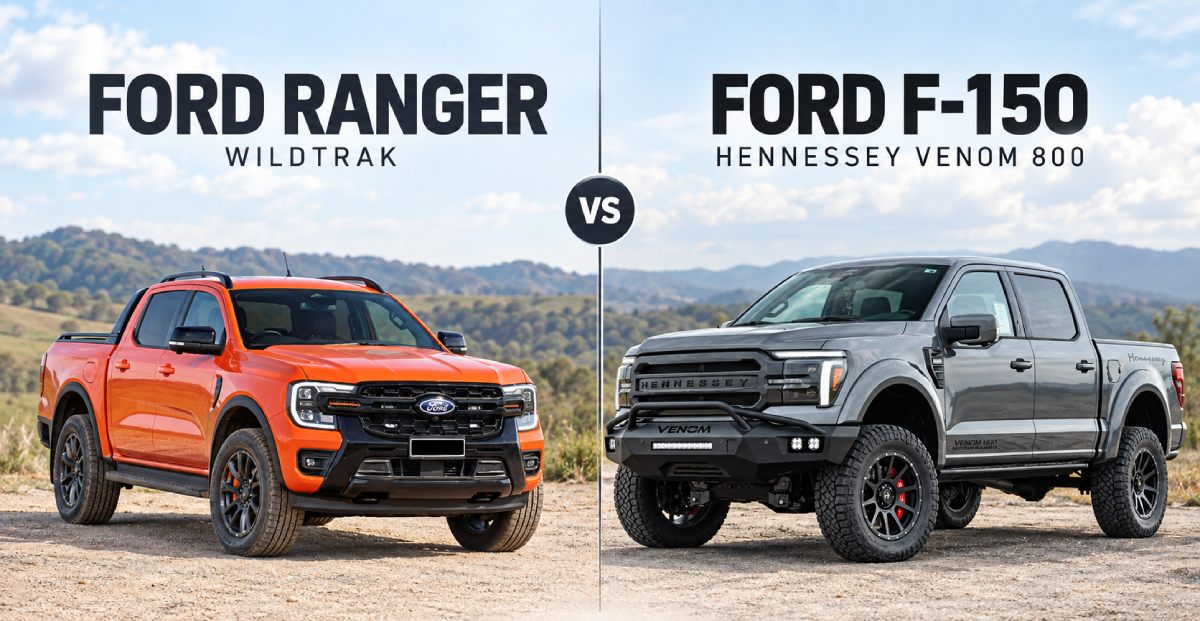
Price and trims: compare the trucks you would actually buy
The lowest starting prices are about $6,000 apart, but that comparison pairs a four-door Ranger with a Regular Cab F-150. If you need a rear seat, price an F-150 SuperCrew alongside the Ranger. Match the drivetrain, towing equipment and features you plan to use before deciding how much the larger truck costs you.
| Trim | Ranger starting MSRP | F-150 starting MSRP |
| XL | $33,550 | $39,585 |
| XLT | $35,575 | $44,695 |
| Lariat | $43,955 | $59,560 |
| Raptor | $57,270 | $79,005 |
These are starting prices for each trim, not quotes for matching equipment. The F-150 also offers STX, Tremor, King Ranch and Platinum trims. A Ranger with the V6, four-wheel drive and several option packages can cost more than a simpler F-150, so compare window stickers rather than trim names alone.
Ask each dealer for the full out-the-door price. If you finance the purchase, compare the loan term, APR and total interest as well as the monthly payment. Reviewing car interest rates based on your credit score can help you assess the financing offer before choosing between the two trucks.
Size, passenger space and bed length
The Ranger’s smaller body helps when parking or driving through narrow streets. The F-150 SuperCrew gives rear passengers more room, which can matter more than engine output when the truck doubles as a family vehicle.
Ford calls its four-door crew cab configuration SuperCrew. Both trucks offer it, but the name does not mean their back seats are the same size. Sit behind the driver with the front seat adjusted to your usual position. Bring your child’s seat if they will travel in the truck.
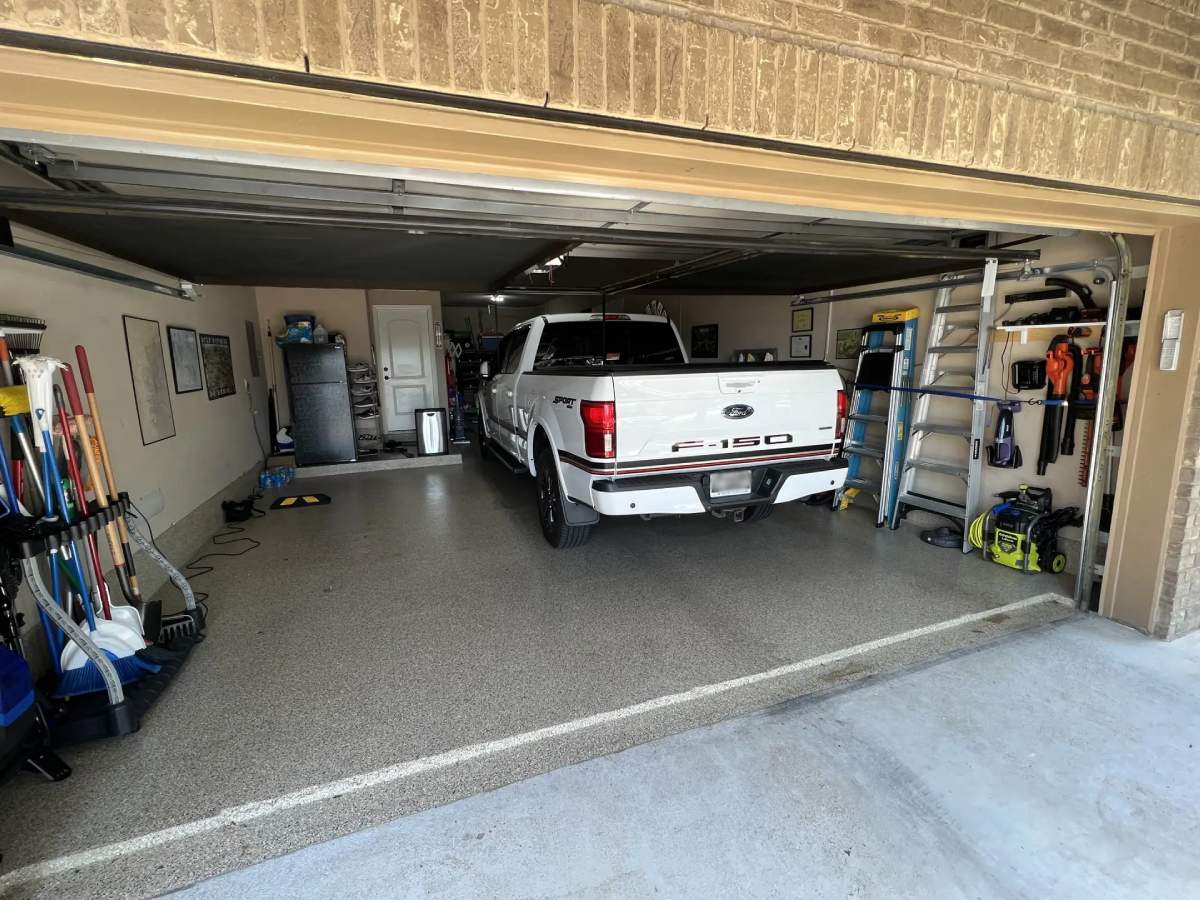
Will it fit in your garage?
The regular Ranger XL, XLT and Lariat body measures about 210.6 inches long and 75.5 inches wide without mirrors. The Raptor has different dimensions. F-150 length depends on the cab and bed; a SuperCrew with a 6.5-foot bed needs more parking space than one with a 5.5-foot bed.
Measure usable garage depth with the door closed, including shelving, steps and anything stored against the wall. For example, a 20-foot clear depth provides about 29 inches of total clearance around a 210.6-inch Ranger. Also check the door opening, mirrors and space to get out. A nominally 20-foot garage does not guarantee that either truck will fit comfortably.
Which bed works for your cargo?
The U.S. Ranger comes with a 5-foot bed. That suits tools, camping equipment and many household loads, but long materials will extend beyond it. F-150 combinations include:
- Regular Cab: 6.5- or 8-foot bed.
- SuperCab: 6.5-foot bed.
- SuperCrew: 5.5- or 6.5-foot bed.
A 4-by-8-foot plywood sheet is longer than the Ranger’s bed and the F-150’s 5.5- or 6.5-foot beds. A 6.5-foot bed cannot contain that eight-foot sheet lengthwise with the tailgate closed. The Ranger’s 48.2-inch width between the wheel wells can accommodate the sheet’s four-foot width, but the overhanging length still needs proper support and securement. An 8-foot F-150 bed is the better starting point if you regularly carry full-length sheets and want to close the tailgate.
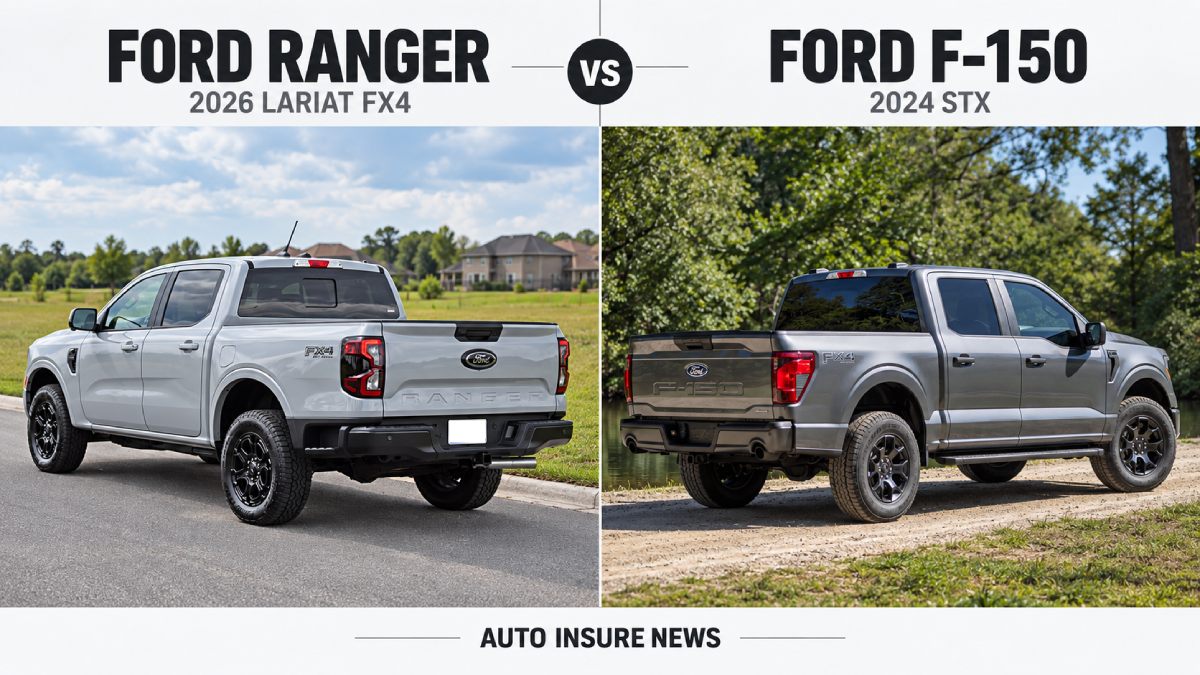
Engines: choose for the work you expect
Ranger engine choices
- 2.3L EcoBoost: 270 hp and 310 lb-ft. The standard engine on XL, XLT and Lariat.
- 2.7L EcoBoost V6: 315 hp and 400 lb-ft. Available on XLT and Lariat with four-wheel drive.
- 3.0L EcoBoost V6: 405 hp and 430 lb-ft. Exclusive to the Ranger Raptor.
All use a 10-speed automatic. The optional 2.7L V6 adds power, but it does not raise the Ranger’s 7,500-pound maximum towing rating. Its maximum available payload is also lower: 1,513 pounds, compared with 1,767 pounds for the 2.3L 4×2. Buying the larger engine is therefore a performance choice rather than an automatic increase in hauling capacity.

F-150 engine choices
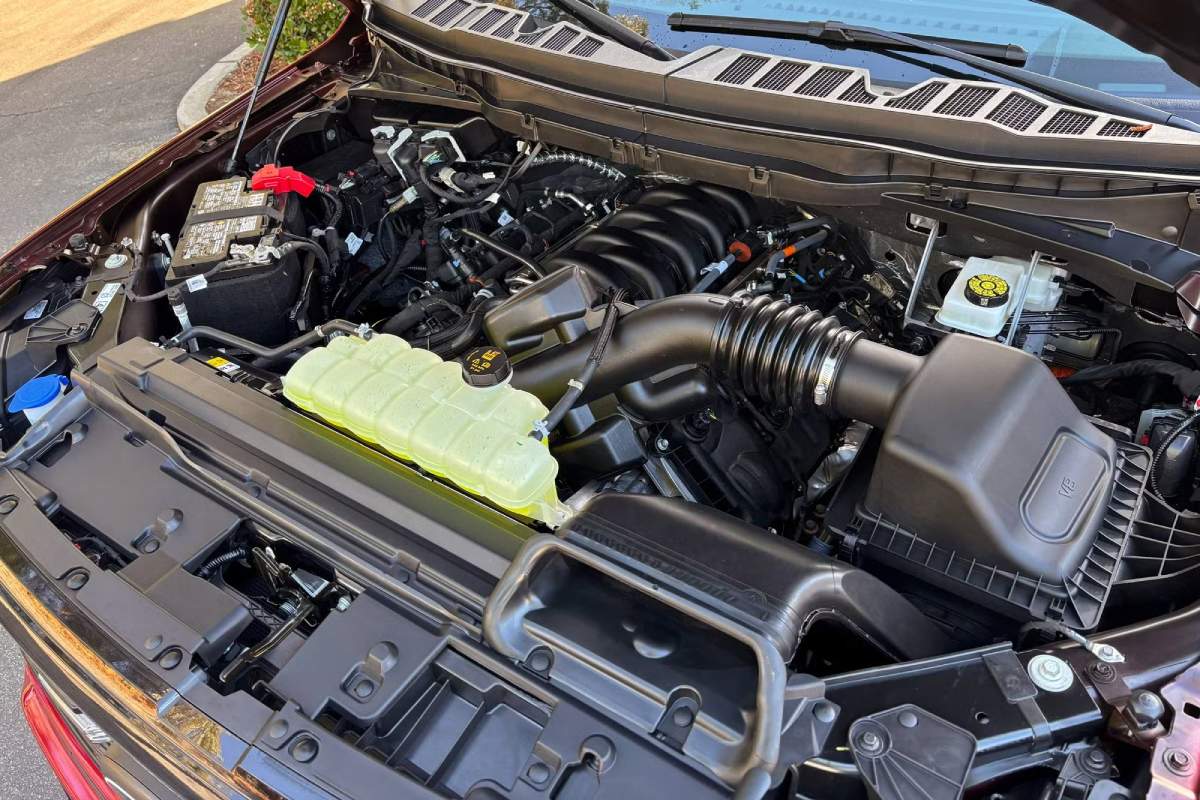
The F-150 offers a 2.7L EcoBoost V6, 5.0L V8, 3.5L EcoBoost V6 and 3.5L PowerBoost hybrid, plus the Raptor’s high-output V6 and the Raptor R’s supercharged V8. Availability depends on trim and configuration.
The 2.7L V6 produces 325 hp and 400 lb-ft, while the 5.0L V8 produces 400 hp and 410 lb-ft. The 3.5L EcoBoost is the engine to investigate for the highest conventional towing rating. The PowerBoost hybrid is worth comparing if fuel use and onboard electrical power are priorities.
The Ranger V6 and base F-150 V6 both offer 400 lb-ft of torque. That alone does not tell you which truck will accelerate, tow or ride better. Vehicle weight, gearing, tires and load also matter. Test-drive the actual engine and drivetrain you are considering.
Towing and payload: check the exact configuration
For occasional towing, the Ranger’s properly equipped 7,500-pound rating may cover your needs. For heavier trailers, some F-150 configurations provide more capacity. The difference is smaller with the F-150’s 2.7L engine, which tops out at 8,400 pounds, than with a qualifying 3.5L EcoBoost truck rated for 13,500 pounds.
Use the trailer’s loaded weight, including water, fuel, equipment, and luggage. A camper’s advertised dry weight excludes those items. Then check the truck’s engine, axle ratio, towing package, hitch limits and ratings for the specific cab and drivetrain.
Why can the payload limit a trailer before the towing capacity does
Payload is the weight the truck can carry: passengers, cargo, added equipment and the load the trailer places on the hitch. You can stay below the advertised towing maximum while exceeding the truck’s payload limit.
Consider an illustrative truck with a 1,500-pound payload allowance. If passengers and luggage total 600 pounds and the trailer puts 750 pounds on the hitch, only 150 pounds remain for other equipment and cargo. Use the actual door-label allowance and measured hitch load for your combination.
A large fifth-wheel needs a separate check of pin weight, axle ratings and installation requirements. An F-150’s 13,500-pound conventional towing headline does not establish that it can tow a particular fifth-wheel. Check the Ford towing guides for the relevant model year and have the dealer confirm the configuration against your loaded trailer.
Fuel economy and annual fuel costs
The Ranger has an efficiency advantage over the selected gas-only F-150 models below. The PowerBoost hybrid can match its combined EPA rating, though it is a different, more expensive configuration.
| 2026 configuration | EPA city/highway/combined mpg | Illustrative annual fuel cost |
| Ranger 2.3L 2WD | 21 / 25 / 23 | $2,283 |
| F-150 2.7L 2WD | 19 / 25 / 21 | $2,500 |
| F-150 5.0L V8 2WD | 16 / 24 / 19 | $2,763 |
| F-150 PowerBoost hybrid 4WD | 22 / 24 / 23 | $2,283 |
Auto Insure News calculated these budget examples using EPA combined ratings, 15,000 miles per year and gasoline at $3.50 per gallon. Formula: annual miles divided by combined mpg, multiplied by fuel price. These are calculations, not road-test results or a forecast for your truck.
Under those assumptions, the Ranger saves about $217 per year compared to the 2.7L F-150 and $481 per year compared to the V8. Towing, tires, weather and driving speed can change actual fuel use. Compare the purchase-price difference as well: matching the Ranger’s mpg does not necessarily make the hybrid cheaper to own overall.
Interior, technology and driver assistance
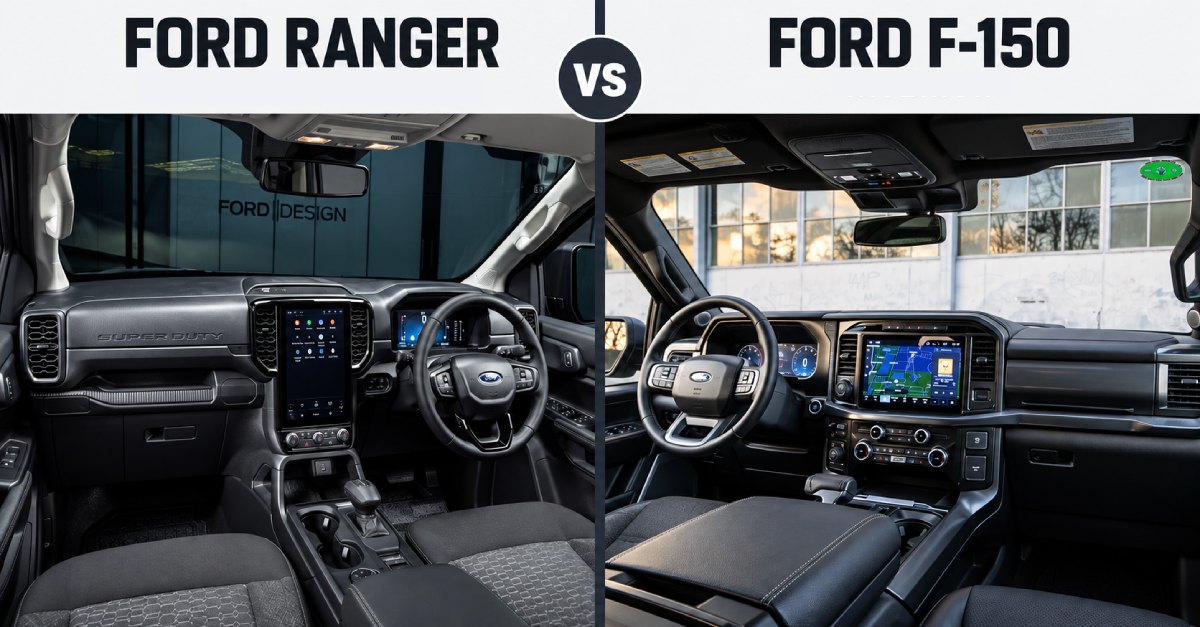
The Ranger uses SYNC 4A, with a 10-inch center display on XL, an available 12-inch display on XLT and a standard 12-inch display on Lariat. The F-150 uses SYNC 4 and has a standard 12-inch center touchscreen. Both support wireless Apple CarPlay and Android Auto.
For family trips or a work crew, compare the seats and storage before paying for a larger screen. The F-150 SuperCrew’s larger cabin is a stronger reason to choose it if adults regularly ride in the back. Upholstery, heated or ventilated seats, audio systems and cameras vary by trim and package.
What BlueCruise adds
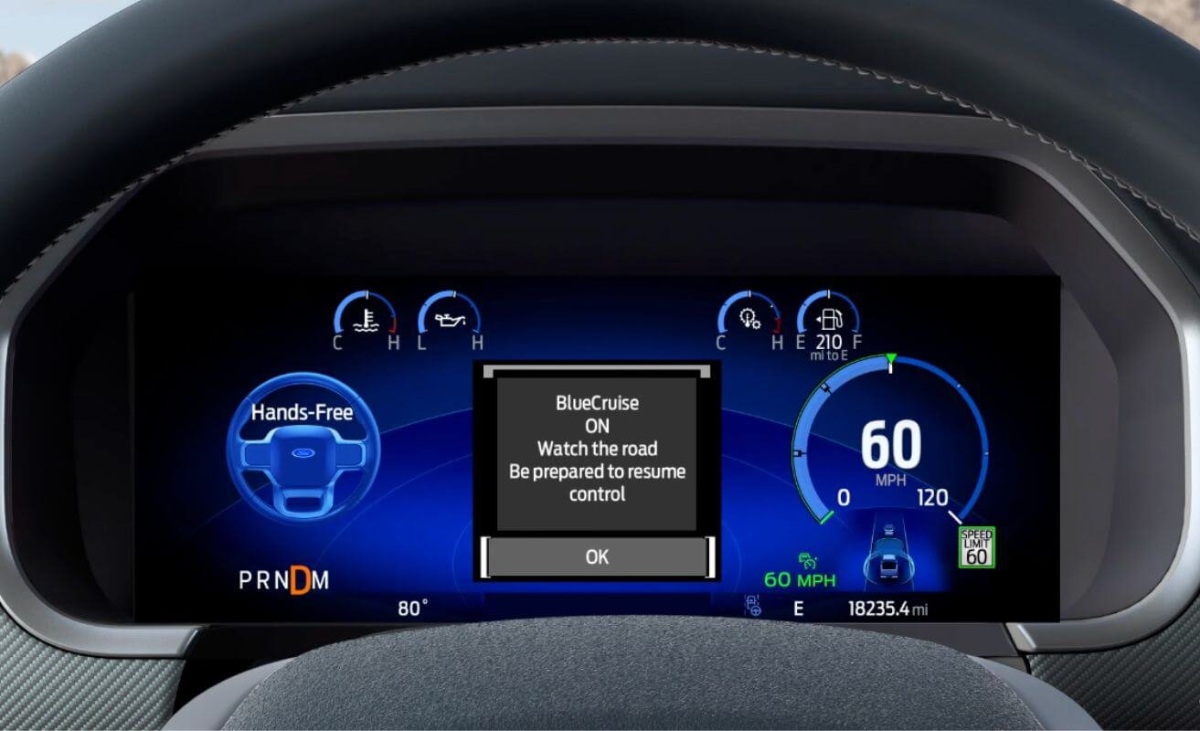
BlueCruise is available on selected F-150 configurations, including some XLT models. The U.S. 2026 Ranger does not offer it. On compatible mapped highways, the system can assist with steering, acceleration and braking while allowing hands-free operation. The driver must remain attentive and ready to take control.
Check that the truck has the required hardware and confirm whether the included trial or paid plan is included. Do not assume the feature remains active indefinitely because it appears on the window sticker. Also, do not buy a 2026 F-150 expecting hands-free towing: Ford introduced BlueCruise with Towing for the 2027 model.
Safety equipment and onboard power
Compare the individual driver-assistance features on the window stickers. For example, the Ranger XLT lists blind-spot monitoring with cross-traffic alert and trailer coverage as standard, while other features and XL equipment differ. The Co-Pilot360 name alone does not establish that two trucks have identical systems.
The Ranger offers up to 400 watts of onboard outlet power. A suitably equipped F-150 PowerBoost offers up to 7.2 kilowatts of power via Pro Power Onboard. That difference can matter if you need to run tools or appliances away from an electrical supply. Match the equipment’s power demand to the truck’s installed system.
Off-road use: FX4 or Raptor?
For dirt roads and occasional trails, compare the available FX4 packages before moving to a Raptor. Check the included tires, protection and traction equipment on the build you want.
The Ranger Raptor combines its 405-hp V6 with FOX Live Valve shocks and locking front and rear differentials. Its smaller footprint may be helpful on narrow trails. The larger F-150 Raptor offers a 450-hp V6, while the Raptor R has a 720-hp supercharged V8. Consider trail width, suspension needs and purchase cost rather than choosing by horsepower alone.
The Raptor versions also have their own towing and payload limits. In particular, the Ranger Raptor’s 5,510-pound towing maximum is lower than the 7,500-pound rating available on other Ranger trims. Buying the off-road flagship does not give you the strongest tow vehicle in the lineup.

Insurance and other ownership costs
Compare insurance before signing for either truck. A lower purchase price does not guarantee a lower premium. Vehicle value and repair costs are only part of what determines your car insurance rate; the drivers, location, claim history, coverage limits and deductibles also matter.
Ask for quotes using the VINs of the trucks you are considering, with matching coverage and deductibles. Add the annual premium to your financing, fuel, maintenance and tire budget. Our guide to getting insurance quotes explains the information to gather for the comparison.
Tell the insurer if you will make deliveries, haul for hire or use the truck in your business. Coverage depends on the activity and policy. Review when you need commercial auto insurance before assuming a personal policy covers the work you plan to do.
Which truck should you buy?
Choose the Ranger when its capacity meets your needs
Start with the Ranger if you want a pickup for commuting, household projects, and occasional towing, and you’re comfortable with its 5-foot bed and rear-seat space. Price the towing package if you need one, and test the back seat with your usual passengers. The smaller truck can leave more money in your budget without sacrificing the capacity your actual loads require.
Choose the F-150 for the space or capability you will use
Compare F-150 configurations if you need a longer bed, regularly carry adults in the rear seat, want available BlueCruise or onboard power, or have loads beyond the Ranger’s limits. Select the engine, axle and packages around those needs. A basic 2.7L F-150 and a maximum-tow 3.5L truck offer different capabilities despite sharing the same badge.
Before deciding, take three things to the dealership: your garage measurements, your trailer’s loaded weight and a list of the people and cargo you usually carry. Compare two actual builds, their out-the-door prices and their insurance quotes. Those numbers give you a more useful answer than the lowest advertised prices or the largest towing figures.

RELATED AUTO INSURANCE GUIDES
Safety & Driving
Black Ice on the Roads: How to spot it and handle a skid
Auto Insurance
Car Insurance Umbrella Policy: Coverage, Cost and Limits
Auto Insurance
Michigan Car Insurance: Rates, Companies & PIP Coverage
Safety & Driving
Texting and driving: risks, statistics, laws and prevention