
The risks of using car insurance tracking devices are easy to overlook when an insurer dangles a tempting discount in front of you. Sign up, drive safely, save money – that’s the pitch, and for some drivers it genuinely works. But car insurance tracking devices can collect detailed information about how much you drive, when you drive, how you brake, how quickly you accelerate, and, in some programs, where you go and how you use your phone.
Before you plug in a device, activate connected-car data, or download a telematics app, it is worth understanding exactly what you are trading for the discount. At Auto Insure News, we evaluate both sides of that trade: how much telematics can realistically save, how often premiums actually fall, which programs can raise rates, what data can be collected, and how that information may be used after an accident.
What are the biggest risks of car insurance tracking devices?
The five biggest risks are a higher premium, loss of privacy, telematics data being used in a claim, inaccurate trip or driving data, and a scoring model that penalizes when or where you drive rather than simply whether you drive safely.
The financial risk is not theoretical. A 2025 Maryland Insurance Administration report provides one of the clearest regulatory datasets currently available.
| 2023 Maryland telematics result | Share of enrolled policies |
|---|---|
| Premium decreased | 31.2% |
| Premium increased | 23.6% |
| No premium change | About 45% |
Source: Maryland Insurance Administration. The figures describe Maryland policies enrolled in telematics and should not be treated as nationwide results.
The same regulator found that telematics enrollment in Maryland increased approximately 45% between 2021 and 2023.
At the national level, J.D. Power’s 2026 U.S. Insurance Shopping Study reports that approximately 20% of auto insurance customers now use usage-based insurance.
That tells us two things: telematics is no longer a niche insurance experiment, but participating does not guarantee a discount.
Before enrolling, understand how do insurance companies determine rates, because telematics typically adds another layer of rating rather than replacing every traditional pricing factor.
What is a car insurance tracking device?
A car tracking device for insurance is the hardware, mobile app, connected-car system, or sensor used to collect driving data for a usage-based insurance program, commonly called UBI or telematics insurance.
It does not replace your insurance policy. Instead, it gives the insurer additional information that can be incorporated into pricing or discounts.
According to the National Association of Insurance Commissioners, telematics systems can measure variables including:
- Miles driven
- Time of day
- Speed
- Rapid acceleration
- Hard braking
- Hard cornering
- Location through GPS
- Phone use
- Airbag deployment
Not every program collects every variable. This is one reason you should read the specific program terms rather than treating all telematics products as identical.
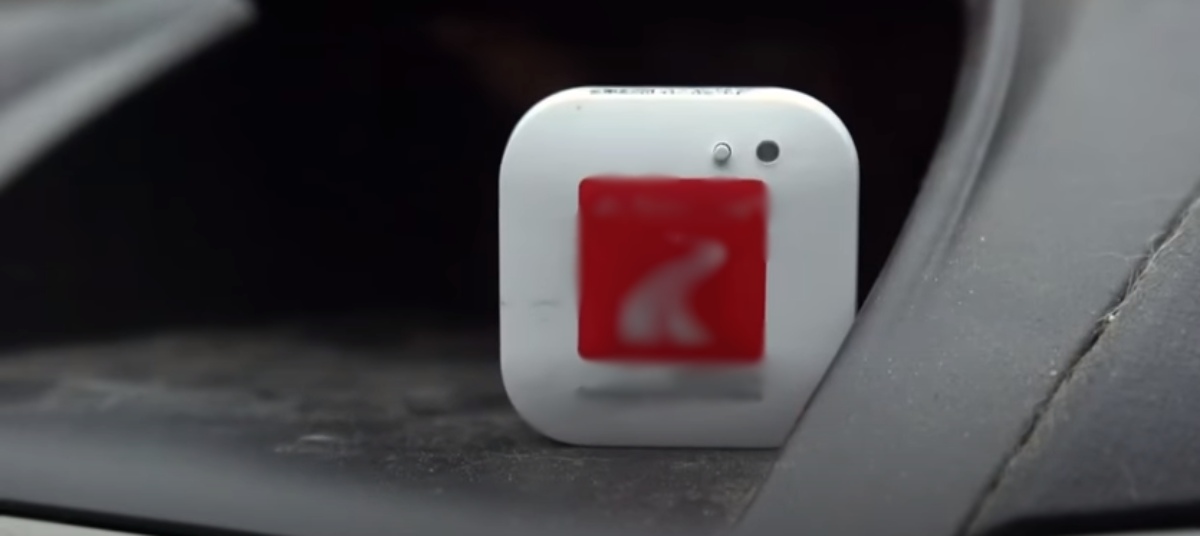
Tracking can happen through:
- A smartphone app using GPS, accelerometer, and other phone sensors.
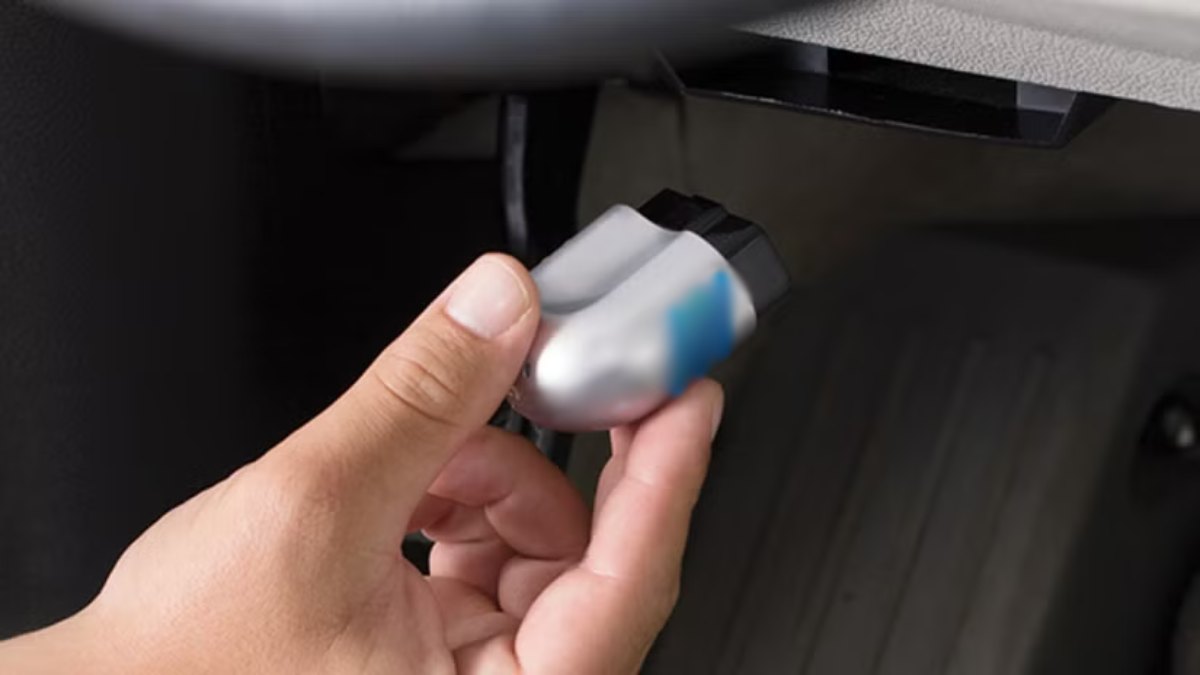
- An OBD-II device is plugged into the vehicle’s diagnostic port.
- A Bluetooth beacon connected to a smartphone.
- A connected vehicle capable of transmitting data directly from the car.
How do car insurance tracking devices work?
Most programs convert recorded driving behavior into a score or rating factor.
The exact formula is proprietary to the insurer, but a simplified process looks like this:
- You enroll in the telematics program.
- The insurer begins collecting specified driving data.
- Trips are recorded over the monitoring period.
- The program evaluates mileage and driving behaviors.
- A driving score or equivalent rating factor is calculated.
- The insurer applies a discount or pricing adjustment in accordance with the program and state rules.
Plug-in devices vs. mobile apps
OBD-II devices receive information from the vehicle, while smartphone programs rely heavily on the phone’s sensors, GPS, permissions, and connection to the vehicle.
Modern programs increasingly use apps because they can also evaluate phone interaction while driving.
How much can telematics actually save?
The advertised maximum and the savings an average participant actually receives are two different numbers.
Current insurer programs illustrate how wide the range is.
| Program | Current advertised savings | Can driving data increase price? |
|---|---|---|
| Progressive Snapshot | Drivers who save currently save an average of about $328 per year | Yes. Progressive says high-risk driving can increase the rate |
| State Farm Drive Safe & Save | 10% initial participation discount; up to about 30% | The current program is structured around a discount; the discount amount varies |
| Nationwide SmartRide | 15% enrollment discount in most states; up to 40% | Nationwide describes SmartRide as providing safe-driving savings without financial risk from the score |
| Liberty Mutual RightTrack | 10% or 15% initial participation discount; up to 30% | Yes. Riskier driving can produce a premium increase |
| Allstate Drivewise | Participation savings plus personalized renewal pricing | Yes, in applicable states. High-risk driving can increase the rate |
| GEICO DriveEasy | Personalized savings based on driving score; no single universal maximum displayed for every state | Yes, in applicable states. GEICO says riskier drivers may receive a higher rate |
Program terms, savings, availability, and whether adverse driving can increase the premium vary by state and can change. Check the insurer’s current program terms before enrolling.
Progressive Snapshot: a useful real-world benchmark
Progressive currently says that drivers who save with Snapshot save an average of $328 per year.
That wording matters.
It does not say every participant saves $328. It measures drivers who actually receive savings.
Progressive also explicitly states that a rate can increase with high-risk driving.
Maximum discounts can look much larger
State Farm advertises Drive Safe & Save discounts of up to approximately 30%.
Nationwide advertises up to 40% through SmartRide, with a 15% participation discount in most states.
Liberty Mutual advertises up to 30% through RightTrack.
Never use the maximum advertised discount amount in your personal budget. Quote the policy both with and without telematics and ask what happens at renewal if your driving score is poor.
Can a car insurance tracking device raise your rates?
Yes. Several major telematics programs can directly produce a higher rate when the recorded driving behavior is classified as higher risk.
Progressive Snapshot, GEICO DriveEasy, Liberty Mutual RightTrack, and Allstate Drivewise all currently disclose circumstances in which telematics results can increase pricing.
The Maryland Insurance Administration’s market data shows why this question matters.
| Maryland 2023 outcome | Share | Approximate policies per 100 enrolled |
|---|---|---|
| Premium decreased | 31.2% | 31 |
| Premium increased | 23.6% | 24 |
| No premium change | About 45% | 45 |
In that Maryland dataset, roughly three out of ten enrolled policies became cheaper while roughly one out of four became more expensive.
This is much more useful than simply quoting an insurer’s “save up to 30%” advertisement.
It is also important not to overgeneralize: Maryland’s numbers are not national averages, and telematics pricing rules vary by insurer and state.
Discount-only programs reduce the downside
Some programs are structured so that a poor telematics score does not directly create a surcharge.
Nationwide currently describes SmartRide as a program in which customers can earn safe-driving savings without financial risk from their driving score.
That does not mean your total renewal premium can never rise. General rate changes, coverage changes, vehicles, drivers, and other rating factors can still change the final price.
Privacy is a real financial risk, not just a theoretical concern
The strongest evidence comes from the connected-car market.
In January 2026, the Federal Trade Commission finalized an order involving General Motors and OnStar after alleging that precise geolocation and driving-behavior information had been collected and sold to third parties, including consumer reporting agencies, without adequate informed consent.
According to the FTC, some precise geolocation data was collected as often as every three seconds.
The final FTC order includes:
- A five-year ban on GM disclosing certain geolocation and driving-behavior data to consumer reporting agencies.
- Requirements for affirmative express consent before specified connected-vehicle data collection or sharing.
- A method for consumers to request copies of their data.
- A method for consumers to seek deletion.
- Options to disable or opt out of certain location and driver-behavior data collection.
Source: Federal Trade Commission.
An important distinction: the GM/OnStar case involved connected-vehicle data and was not simply a conventional insurer-run voluntary UBI program. It remains highly relevant because modern vehicles can generate driving data beyond the telematics app you intentionally enrolled in.
Not every insurer sells telematics data
Do not make the opposite mistake and assume every insurance company sells driver data.
Current insurer disclosures differ substantially.
| Program | Current privacy position |
|---|---|
| State Farm Drive Safe & Save | State Farm says it does not sell program information, although limited third-party sharing can occur under its privacy policy |
| Nationwide SmartRide | Nationwide states that SmartRide data is used for insurance purposes and is not sold to third parties |
| Allstate Drivewise | Driving data collection is powered by Allstate affiliate Arity; Allstate directs users to Arity’s privacy statement for collection and sharing details |
| Progressive Snapshot | Progressive retains Snapshot information under its retention policies and provides detailed terms governing rating, claims and legal use |
The privacy question should therefore be insurer-specific: what does this company collect, who receives it, how long is it retained, and what uses did you consent to?
What can your location data reveal?
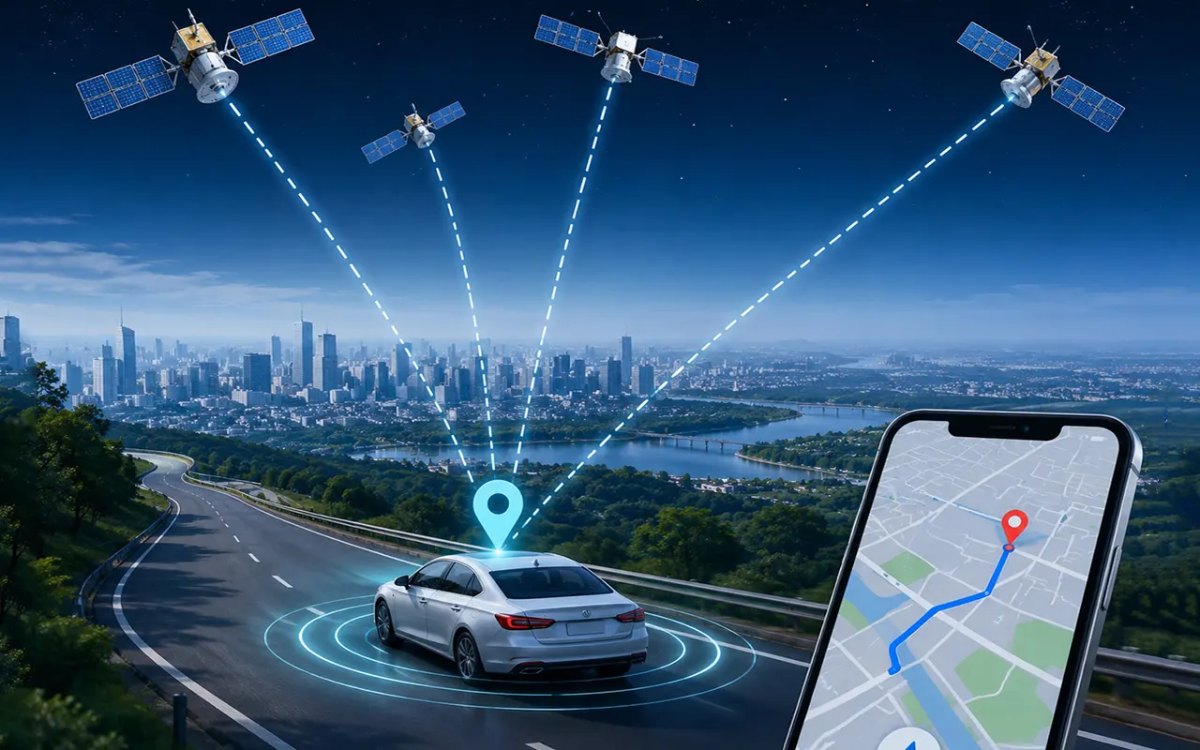
Precise GPS information can reveal far more than mileage.
A detailed trip history can indicate:
- Where you live
- Where you work
- Your daily commuting schedule
- Hospitals or medical facilities you visit
- Stores and businesses you frequent
- Regular overnight locations
- When your vehicle is normally away from home
That is why precise geolocation is materially more sensitive than a simple annual odometer reading.
Can telematics data be used against you in an insurance claim?
Yes. At least some major telematics programs explicitly allow insurers to use collected data when resolving claims.
Progressive’s current Snapshot terms are particularly clear.
Progressive states that Snapshot data can be used to assist in resolving an insurance claim, including:
- Confirming the date and time of an accident
- Confirming crash location
- Making liability determinations
- Making coverage determinations
- Investigating fraud
- Investigating material misrepresentation
- Subrogation
- Litigation related to the claim
Source: Progressive Snapshot Terms and Conditions.
Progressive’s mobile terms also warn that relevant information may need to be preserved after an accident and can potentially be sought in civil litigation or by law enforcement.
This does not mean telematics data automatically causes claim denial. In many cases, the same data can support your version of the accident.
For example, recorded location, time, vehicle movement, or crash information could help verify that you were where you said you were and support a liability investigation.
The important point is that data collected to calculate a discount can have a second life during a claim.

Tracking apps can record the wrong trip or driver
Smartphone telematics is not automatically perfect simply because the app produces a precise-looking score.
Programs have to distinguish between:
- You’re driving your own car
- You’re riding as a passenger
- Another household member is driving
- Public transportation
- A trip in another vehicle
State Farm’s current Drive Safe & Save documentation provides a useful real-world example. The company allows users to reclassify certain trips, and doing so can remove phone distraction recorded during that trip from the driver’s score.
State Farm also warns that incorrectly positioning its Bluetooth beacon can affect event accuracy and that a weak Bluetooth connection can affect trip recording.
This is why you should review the trip log rather than assume the score is correct.
Hard braking does not always mean unsafe driving
A sensor records the deceleration. It does not fully understand why you braked.
Hard braking can result from:
- A pedestrian entering the road
- A vehicle cutting into your lane
- Traffic stopping suddenly
- An animal crossing
- Emergency vehicles
- Poor weather or road conditions
Repeated hard braking can still correlate with higher driving risk, but individual events can be completely justified.

Your schedule can hurt your telematics score even without a ticket
Several major programs consider not merely whether you receive traffic tickets, but also when you drive.
That creates a structural problem for drivers who cannot choose their schedule.
| Driver profile | Why telematics may be less attractive |
|---|---|
| Night-shift worker | Frequent late-night driving can be treated as a higher-risk exposure |
| Urban commuter | Dense traffic creates more braking and acceleration events |
| High-mileage commuter | More miles mean greater road exposure |
| Delivery driver | High mileage, repeated stops, and urban traffic can weaken a score |
| Parent making many short trips | Trip frequency and heavy traffic can create more recorded events |
| Remote worker | Low mileage can make telematics substantially more attractive |
A safe driver and a telematics-friendly driver are not always the same person.
If the device does not fit your driving pattern, compare other ways to how to save money on auto insurance instead of accepting a discount that may expose more data than you want to share.
Could telematics change the way you drive?
Feedback can improve driving behavior, but drivers should not chase the app score at the expense of real-world safety.
Do not:
- Avoid necessary hard braking because you are protecting a score.
- Roll through a stop to avoid a braking event.
- Accelerate too slowly into fast-moving traffic simply to protect an acceleration score.
- Focus on a telematics notification while driving.
The safest maneuver should always take priority over the cleanest telematics trip.
What are the benefits of car insurance tracking devices?
The risks are real, but so are the advantages.
1. Potential savings
A genuinely low-risk driver can receive meaningful savings.
Current examples include:
- Progressive: approximately $328 average annual savings among Snapshot customers who save.
- State Farm: up to approximately 30%.
- Nationwide SmartRide: up to approximately 40%.
- Liberty Mutual RightTrack: up to approximately 30%.
Again, these figures use different methodologies. A maximum discount and an average savings among people who saved should never be compared as though they are the same statistic.
2. Low-mileage drivers can prove they drive less
Traditional insurance may estimate annual mileage using information reported during the application.
Telematics can provide more direct evidence that a driver travels relatively few miles.
This can make the programs particularly interesting for:
- Remote workers
- Retirees
- Households with a rarely used second vehicle
- Drivers who commute primarily by transit
Low-mileage drivers should compare the device’s actual savings with insurance for low milage drivers before giving up driving data solely for a telematics discount.
3. Driving feedback
Many apps show:
- Hard-braking events
- Acceleration
- Speed-related behavior
- Phone distraction
- Trip history
- Driving scores
That feedback can identify habits a driver did not realize were frequent.
4. Crash detection and claims support
Some insurers now use connected or telematics technology to detect a possible crash and offer assistance.
Allstate Drivewise, Liberty Mutual RightTrack and other programs advertise crash-detection or accident-assistance functions in current versions of their apps.

Are car insurance tracking devices worth it?
They are worth considering when you drive relatively few miles, avoid late-night driving, have predictable habits, and are comfortable exchanging driving data for a chance at lower pricing.
They are less attractive when you drive long distances, regularly drive at night, work in dense urban traffic, perform delivery work, or strongly value location privacy.
| Potential benefits | Potential risks |
|---|---|
| Enrollment discount with some insurers | Some programs can raise your rate |
| Potential savings based on real driving | Maximum advertised savings are not guaranteed |
| Low mileage can be rewarded | High mileage can work against you |
| Driving feedback | App or sensor data can be inaccurate |
| Crash detection | Data can become relevant to a claim |
| More individualized pricing | Location and behavioral privacy concerns |
| Can reward predictable low-risk driving | Night workers and heavy urban drivers can be disadvantaged by the scoring model |
For drivers considering telematics primarily as a savings strategy, compare the quote carefully to see whether you may be am i paying too much for car insurance.
Who should consider a car insurance tracking device?
Telematics is most effective when the insurer’s model aligns with how you already drive.
Good candidates
- Low-mileage drivers
- Remote workers
- Retirees
- Drivers who rarely travel late at night
- Drivers with smooth acceleration and braking habits
- Drivers who do not frequently use their phones behind the wheel
- Drivers comfortable sharing the required data
Drivers who should be cautious
- Night-shift workers
- High-mileage commuters
- Drivers in very congested cities
- Rideshare drivers
- Delivery drivers
- Drivers who frequently lend their phone or vehicle to others
- People are strongly concerned about location privacy
- Drivers unable or unwilling to review trip classifications regularly
What to check before enrolling in a telematics program
Do not enroll until you can answer these questions.
| Question | Why it matters |
|---|---|
| Can my rate increase because of the score? | Separates discount-only programs from programs carrying downside pricing risk |
| What is the initial discount? | Shows the guaranteed or participation component |
| What is the average actual savings? | More useful than the maximum advertised discount |
| What behaviors are scored? | Determines whether your normal schedule fits the model |
| Is the GPS location collected? | Major privacy consideration |
| Is phone use recorded? | Can materially affect app-based scores |
| Can I correct an incorrectly classified trip? | Reduces the risk of bad data affecting your score |
| How long is the data retained? | Determines long-term privacy exposure |
| Is the data shared with third parties? | Not every program follows the same privacy model |
| Can the data be used in claims? | Important after a collision |
| What happens if I opt out? | You can lose participation discounts or trigger other pricing adjustments |
How to check whether your connected car is already sharing driving data
You do not necessarily need to enroll in a traditional insurance telematics program for driving data to be collected.
Maryland’s insurance regulator currently warns consumers that newer vehicles and manufacturer apps can collect information such as speed, braking and acceleration and that this information can potentially be shared with third parties, including insurers.
Check:
- Your automaker account.
- The vehicle’s connected-services settings.
- The manufacturer’s mobile app permissions.
- Privacy and data-sharing selections in the infotainment system.
- Whether you opted into a driver-score or safe-driving service.
- Your available consumer reporting data.
The Maryland Insurance Administration also advises consumers that they can request relevant driving data from LexisNexis.
This distinction is important: insurance telematics and manufacturer-connected vehicle data are separate data channels, and turning off one does not automatically disable the other.
How to reduce the risks if you decide to enroll
- Prefer a discount-only structure when available. This limits the direct downside from a weak driving score.
- Read the privacy terms before enrollment. Look specifically for GPS, retention, sharing, claims use, and opt-out language.
- Review trips regularly. Correct passenger trips or other errors when the program allows it.
- Check your first renewal carefully. Compare the final telematics adjustment against the participation discount.
- Do not alter safe driving simply to protect a score.
- Take screenshots of important scores and trip corrections.
- Know how to leave the program. Some programs treat early opt-out differently from leaving after the monitoring period.
- Compare the final premium with non-telematics insurers.
Alternatives to car insurance tracking devices
A telematics discount is worthless if another insurer will sell you the same coverage for less without tracking you.
For example:
| Option | Annual premium |
|---|---|
| Current insurer without telematics | $2,400 |
| Current insurer with 10% telematics savings | $2,160 |
| Competing insurer without telematics | $1,950 |
In this simplified example, the 10% telematics discount saves $240, but switching insurers saves $450 more without sharing driving data.
Compare insurers first
Before enrolling, obtain conventional quotes using identical coverage.
When comparing quotes, keep the vehicle, drivers, liability limits, UM/UIM protection, and deductibles consistent. This makes it easier to evaluate the factors to consider when choosing car insurance before choosing a tracking program.
Use non-tracking discounts
Ask about:
- Multi-policy discounts
- Multi-car discounts
- Accident-free discounts
- Low-mileage discounts based on odometer reporting
- Defensive-driving discounts were available
- Anti-theft discounts
- Paid-in-full discounts
- Autopay
- Paperless billing
Re-shop at renewal
Rates change even when your driving record does not.
Our guide to how often do you have to renew your car insurance explains when a fresh quote comparison is worth running.
How Auto Insure News evaluates car insurance tracking devices
A telematics program should be evaluated as both an insurance pricing decision and a data privacy decision.
At Auto Insure News, we evaluate a program using five numbers or questions:
- What is the guaranteed participation discount? A 10% initial discount has a different value from an advertised “up to 40%” maximum.
- What do actual participants experience? Maryland’s regulatory data found 31.2% received lower premiums, 23.6% received higher premiums, and about 45% saw no change in 2023.
- Can your score increase the premium? Progressive, GEICO, Liberty Mutual, and Allstate currently disclose circumstances in which they can.
- What data are you giving away? Mileage is a much smaller privacy trade than continuous GPS, trip, and phone-behavior information.
- Can another insurer beat the price without tracking? The final premium matters more than the percentage printed on the telematics advertisement.
Our recommendation: get the non-telematics price first, then calculate the dollar savings required to make monitoring worthwhile. A low-mileage driver who can save $300 or $400 per year through a discount-only program may have a strong case for enrolling. A night-shift worker being offered a small participation discount through a program that can also raise the premium has a much weaker case. Never give an insurer detailed driving and location data merely because the advertisement says “save up to 30%.” Find out what drivers actually save, whether you can lose money, which data is collected, and how those data can be used before you opt in.

RELATED AUTO INSURANCE GUIDES
Safety & Driving
Black Ice on the Roads: How to spot it and handle a skid
Auto Insurance
Car Insurance Umbrella Policy: Coverage, Cost and Limits
Auto Insurance
Michigan Car Insurance: Rates, Companies & PIP Coverage
Safety & Driving
Texting and driving: risks, statistics, laws and prevention