

A car accident can leave you dealing with more than just vehicle repairs. It often raises questions about who will pay for medical treatment. With both health insurance and auto insurance potentially involved, understanding which policy applies isn’t always straightforward. Auto Insure News takes a closer look at whether health insurance covers car accidents, how different types of coverage may work together, and the key factors that can affect your medical bills after a crash.
Does health insurance cover auto accident injuries?
Yes. Private health insurance generally covers injuries from a car crash the same way it would cover any other illness or injury (doctor visits, surgery, hospital stays, physical therapy, and prescriptions), regardless of who was at fault. For many people, it is the fastest and most reliable way to get medical bills paid after a collision.
But there are two big catches. First, health insurance may not be the first to pay. Depending on your state and your auto policy, PIP, MedPay, or other auto coverage may have to pay before your health plan covers the remaining eligible bills. Second, health plans can still apply deductibles, copays, coinsurance, network rules, and accident-related coordination-of-benefits rules. Knowing which one pays first is the best way to avoid surprise bills.
Who may pay first after a car accident?
The payment order depends on your state, your auto policy, your health plan, and how fault is determined. When PIP or MedPay applies, it may pay some medical bills before health insurance does. If those benefits are unavailable, exhausted, or do not apply, your health insurance may cover eligible treatment, subject to its normal rules. The at-fault driver’s liability insurer usually pays later through an auto insurance claim or settlement, not right away at the hospital.
| Potential payer | When it may pay | Important limit |
|---|---|---|
| PIP | Required or available in some states; pays regardless of fault | Limits and covered benefits vary by state |
| MedPay | Optional in many states; pays accident-related medical bills | Usually limited to medical costs and policy limits |
| Health insurance | May pay covered treatment when auto medical benefits are unavailable, exhausted, or secondary under the applicable rules | Deductibles, copays, network rules, and reimbursement rights may apply |
| At-fault driver’s liability insurance | May reimburse medical bills, lost wages, and pain and suffering later | Usually paid after fault is accepted or a settlement is reached |
Some states also have special coordination rules. New Jersey, Michigan, and Massachusetts, for example, each have rules that can affect how PIP and health insurance interact. Because these rules are state-specific, check your auto policy, health plan, and guidance from your state insurance department before assuming which coverage pays first.
PIP vs. MedPay vs. health insurance. What’s the difference?
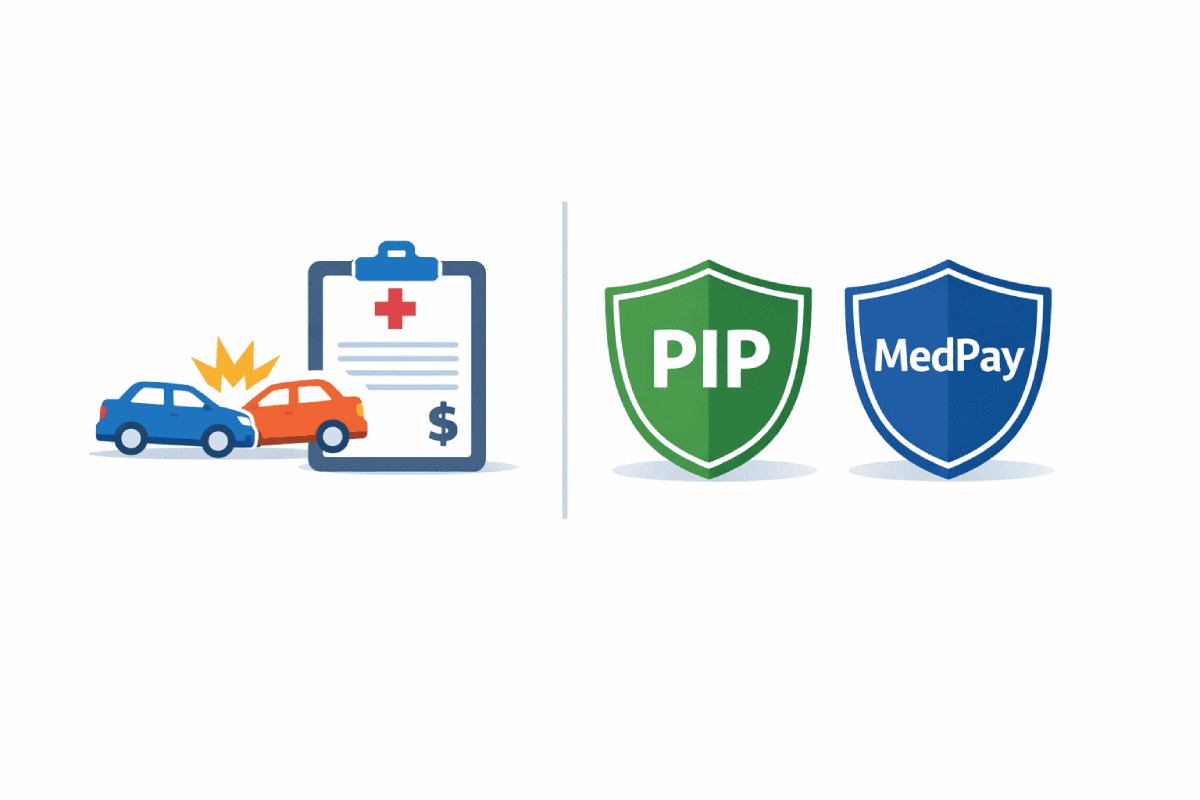
Three different coverages can pay accident medical bills, each working in a distinct way. Drivers should also understand the main types of car insurance so they know how PIP, MedPay, UM/UIM, liability, collision insurance, and comprehensive coverage fit into a broader policy.
| Coverage | What it may pay | Required? | Lost wages? | Repayment risk? |
|---|---|---|---|---|
| PIP (Personal Injury Protection) | Medical bills and, in some states, lost income or essential services | Required in some states; optional or offered in others | Sometimes | Depends on state law and policy terms |
| MedPay (Medical Payments) | Accident-related medical bills | Usually optional | No | Depends on state law and policy terms |
| Health insurance | Covered medical treatment after plan rules apply | Not an auto coverage | No | May have reimbursement or subrogation rights |
PIP is the most comprehensive of the three. In Texas, for example, insurers must offer at least $2,500 per person in PIP unless the driver rejects it in writing, and it pays reasonable medical and funeral expenses, plus 80% of lost wages (or essential services costs for someone who is unemployed) within three years of the accident. MedPay is narrower, covering only medical bills, while health insurance offers the broadest medical coverage, but applies your deductible, copays, and network restrictions.
Do you still need PIP or MedPay if you have health insurance?
PIP or MedPay can still be worth considering even if you have health insurance, for a few reasons:
- It pays first, with no deductible. PIP and MedPay cover accident bills from the first dollar, which can spare you the deductible and copays a health plan would charge.
- PIP covers more than medicine. It can replace lost wages and pay for household help. Health insurance never touches those costs.
- It may be mandatory. No-fault states require PIP, so opting out is not an option there.
- Some health plans limit auto-accident care. A handful of plans exclude auto injuries or restrict you to a narrow provider network; PIP and MedPay fill those gaps.
In at-fault states, some drivers with good health insurance drop MedPay to shave a bit off their premiums. Whether PIP or MedPay is worth the extra cost really comes down to your state, your health plan, your auto policy, your savings, and how much risk you’re comfortable with. There’s no single right answer.
Does it matter if you live in a no-fault or at-fault state?
Yes, this is one of the biggest variables. In a no-fault state, PIP is mandatory and pays your medical bills quickly, regardless of who caused the crash; you can sue the at-fault driver only if your injuries meet a certain threshold. In New York, for example, PIP pays economic losses fast but has firm dollar limits and pays nothing for pain and suffering.
In an at-fault (tort) state, there is no mandatory PIP, so injured drivers rely more heavily on health insurance and on the at-fault driver’s liability coverage. Knowing which system your state uses tells you where your bills will be paid from first.

What car accident costs does health insurance NOT cover?
Health insurance is powerful, but it has clear limits after a crash:
- Your deductible, copays, and coinsurance. These out-of-pocket costs remain your responsibility.
- Lost wages. Health insurance does not replace the income you lose while recovering.
- Pain and suffering. This kind of payout comes only from the at-fault driver’s insurance, never from a health plan.
- Out-of-network or alternative care. Treatment outside your plan’s network may be reduced or denied.
- Vehicle costs of any kind. Health insurance never pays for car repairs, rental cars, towing, or property damage. Those are handled through auto coverages such as collision, rental reimbursement, or the at-fault driver’s property damage liability.
What happens when another driver causes the accident?
When someone else is at fault, their bodily injury liability coverage is ultimately responsible for your medical bills, lost income, and pain and suffering. If you are worried about renewal pricing after a not-at-fault crash, review whether my insurance goes up if someone hits me before assuming the claim can never affect your premium. In Texas, for instance, at-fault drivers must carry at least $30,000 per injured person and $60,000 per accident.
The catch is timing. The at-fault driver’s insurer usually pays only after fault is determined and the claim is settled, which can take months. That’s why your health insurance, PIP, or MedPay steps in to keep your doctors and hospital paid in the meantime. Once your claim settles, you can get reimbursed, but that reimbursement is exactly what triggers the repayment rules below.

Subrogation, reimbursement, and medical liens
If your health insurance pays medical bills after a car accident and you later receive an injury settlement, the health plan may have the right to recover some of the money it paid. This is why a settlement is not always yours to keep in full.
Three related terms often come up:
- Subrogation: the health plan seeks repayment from the at-fault driver or that driver’s insurer for bills it paid on your behalf.
- Reimbursement: the health plan requires you to repay it from your settlement funds.
- Medical lien: a hospital, medical provider, Medicaid, Medicare, or another payer places a legal claim on part of your settlement.
The exact rule depends on your health plan, your state, and whether the plan is employer-sponsored. Some states limit how much an insurer can recover if you have not been fully compensated for your losses, but employer health plans can follow different federal rules. For a serious accident or a large settlement, keep all bills and insurance statements, notify both insurers, and speak with a qualified attorney before signing a release.
When the other driver is uninsured or underinsured
Roughly one in seven U.S. drivers is uninsured, so this scenario is common. Drivers can also review what happens if you have a car accident without insurance to understand the financial risk when an at-fault driver has no active policy. Two coverages on your own policy can help:
- Uninsured motorist (UM): pays when the at-fault driver has no insurance.
- Underinsured motorist (UIM): pays when the at-fault driver’s limits are too low to cover your injuries.
UM/UIM coverage can pay for medical bills and, in many states, pain and suffering. Your health insurance may still pay for covered treatment while a UM/UIM claim is being worked out, and if that claim later pays for your medical bills, reimbursement or subrogation rules can apply. Because so many drivers are uninsured, UM/UIM is one of the most valuable optional coverages a driver can buy.
What to do if health insurance denies a car accident claim
A denial is not necessarily the end of the road. Common reasons include coordination-of-benefits rules (auto must pay first), an auto-accident exclusion in the plan, or out-of-network treatment. Steps to take:
- Read the denial letter and EOB carefully to identify the exact reason.
- Submit the claim to PIP, MedPay, or the at-fault driver’s liability insurer if auto coverage is supposed to pay first.
- File an appeal with complete medical records and documentation.
- Escalate to your state insurance department or a personal injury attorney if the denial stands.
How to submit car accident medical bills correctly
Getting the paperwork right protects both your health and your settlement:
- Notify both insurers. Report the crash to your auto and health insurers promptly. If time has already passed, review how long you have to make a claim after an accident before assuming the medical or auto claim is too late.
- Give providers both insurance cards. This lets the hospital bill in the correct order.
- Keep every record. Save bills, EOBs, receipts, and correspondence.
- Don’t sign waivers in a hurry. A signature can affect your right to recover later.
- Consult an attorney for large or disputed claims. Especially when the fault is contested or the bills are high.
How to find the right coverage and compare rates
The best protection against surprise accident bills is the right mix of coverage before a crash: adequate PIP or MedPay, solid health insurance, and UM/UIM coverage. Because prices and rules vary so much by state and insurer, learning how to get auto insurance quotes is the only reliable way to know what you’ll pay for PIP, MedPay, UM/UIM, liability limits, and other coverage options.
If you compare quotes, line up the same coverage limits and deductibles across insurers, and check how medical payments coverage works in your state. To help with that, Auto Insure News offers a free rate-comparison sign-up at the bottom of this page: enter your email and state to receive coverage tips and rate updates. It’s free, and you can unsubscribe anytime.

RELATED AUTO INSURANCE GUIDES
Safety & Driving
Hot Car Safety Tips for Children, Pets and Drivers
Safety & Driving
How Does a Learner’s Permit Work? Rules and Next Steps
Safety & Driving
Thunderstorm Safety Tips at Home, Outdoors and in a Car
Auto Insurance
ACV vs Replacement Cost: How Insurance Payouts Differ