

Age is one of the many factors insurance companies consider when calculating premiums, but that doesn’t mean your rates automatically decrease every year. While younger drivers often pay the highest prices, the relationship between age and insurance costs can change over time and vary by insurer, driving history, and location. Auto Insure News examines whether car insurance gets cheaper as you get older, explains why rates tend to rise or fall at different life stages, and shares practical tips for keeping your premiums as low as possible.
Does car insurance get cheaper as you get older?
For most drivers, the answer is yes – car insurance rates by age follow a predictable downward trend through early and middle adulthood, before reversing later in life. The single biggest reason is experience: the longer you drive without claims, the less risky you look to an insurer, and lower risk means a lower premium.
Here’s the lifecycle in plain terms:
- Teens and early 20s: the most expensive years by far.
- Mid-20s through 40s: rates fall and then settle.
- 50 to 65: typically the cheapest stretch of your life.
- 70 and beyond: rates tend to rise again.
But there’s an important catch: age alone does not guarantee cheaper insurance. A 45-year-old with multiple at-fault accidents may pay more than a 27-year-old with a clean record. According to the National Association of Insurance Commissioners, age, driving experience, driving record, and accident history are all common rating factors – and younger, less experienced drivers generally pay more.

Why does age affect car insurance rates?
Auto insurance rates by age are tied to how insurers estimate risk – they don’t price on age alone, but on patterns in driving behavior, accident frequency, and claim severity. Age is a useful input because different age groups have measurable differences in experience and accident risk.
This is called risk-based pricing. Insurers start with the average claims behavior of everyone who shares your key traits – age, location, vehicle – then adjust for your personal history. Younger drivers, as a group, file more frequent and more severe claims, so the group rate is high. As that group ages and demonstrates safer behavior, the expected claim cost falls, and so does the price.
Your premium is also shaped by factors beyond age:
- Driving record and claims history
- ZIP code or location
- Annual mileage
- Vehicle make, model, and repair cost
- Coverage limits and deductible
- Credit-based insurance score (where allowed). If credit is raising your premium more than age is lowering it, compare insurance options for drivers with weaker credit before assuming your age group is the main problem.
- Marital status (where allowed)
- State insurance regulations and available discounts
The Insurance Information Institute explains that location, repair costs, theft risk, and vehicle characteristics all help determine price. That’s why two people of the same age can pay very different premiums. (For a neutral primer on how insurers pool and price risk, Wikipedia’s overview of vehicle insurance is a solid starting point.)
When does car insurance usually go down?
When does car insurance go down is one of the most common questions drivers ask after years of high premiums. In most cases, rates begin to improve once drivers leave the highest-risk young-driver category and build a clean insurance history – but there’s no universal birthday when it happens automatically.
Teen years: usually the most expensive stage
Drivers aged 16–19 pay the most, and it’s not close. Per mile driven, teens are involved in nearly three times as many fatal crashes as older age groups, so insurers price that elevated risk into every policy. Adding a teen to a family policy can sharply increase the premium – even for a careful driver. Families in this stage should compare coverage choices for teen drivers before assuming their current insurer is still the best option.
Early 20s: rates start to improve
Drivers in their early 20s often begin to see lower premiums, especially after avoiding accidents and violations. The most dramatic reductions tend to land at ages 19 and 21. At this stage, a clean record is critical – one at-fault accident can delay the rate improvements that usually come with age.

Does car insurance go down at 25?
Turning 25 is the most famous milestone, and rates usually do dip – but it’s smaller than the legend suggests. By 25, most insurers stop classifying you as a “youthful operator,” which often results in a noticeable final drop (Progressive cites roughly a 9–10% decrease around this age). The catch: a clean driving record is what unlocks it. An at-fault accident right before your 25th birthday can cancel out the age benefit entirely.
30s, 40s, and 50s: often the most stable period
Through your 30s to 50s, rates ease and then largely plateau. You’re no longer paying the inexperience penalty, and you often gain access to more discounts – bundling, multi-car, safe-driver, and loyalty. This is also where many drivers stop checking their rate, which is a costly habit.
60s and beyond: rates depend more on the individual
Some drivers in their 60s keep affordable rates, especially with low mileage and a clean record. Others see increases depending on insurer data and state rules. The pattern becomes far more individual after this point.

Why car insurance may get cheaper as you get older
A mature driver discount is one reason premiums fall with age, but it’s not the only one. Older drivers often benefit from safer habits, a longer insurance history, lower mileage, and broader eligibility for discounts – all of which reduce perceived risk.
You have more driving experience
Experience signals how you respond to real road conditions. Someone who has driven for 20 years without major claims gives insurers more confidence than a driver with a six-month license. A longer clean history works in your favor when insurers evaluate risk.
You may have a cleaner driving record
A clean driving record is one of the strongest ways to keep costs down. Avoiding speeding tickets, at-fault accidents, DUIs, and frequent claims helps you qualify for the best rates. This is where age and behavior work together – getting older helps most when your record backs it up.

You may drive less
Many drivers log fewer miles as they age, especially after retirement or a shift to remote work. Lower annual mileage reduces accident exposure and may qualify you for a low-mileage discount. If your habits have changed, tell your insurer – many people overpay on outdated mileage assumptions.
You may qualify for more discounts
With age, you may unlock discounts that weren’t available when you were younger:
- Safe-driver and mature-driver discounts
- Defensive-driving course discount
- Low-mileage discount
- Multi-policy (bundling) and multi-car discounts
- Anti-theft and vehicle safety-feature discounts
- Pay-in-full and paperless billing discounts
The NAIC lists mature-driver discounts, driver-education courses, anti-theft devices, low mileage, and auto/home bundling as common ways to save.
Expert tip: Don’t assume your insurer automatically applies every discount. Ask directly – especially after a life change like retirement, a move, paying off a car, or a shorter commute.
Why car insurance may get more expensive for older drivers
Car insurance for seniors can still be affordable, but premiums may rise for some older drivers depending on age, state rules, and individual driving history. Comparing senior-friendly auto insurance options can help older drivers avoid overpaying after rates begin to climb. This doesn’t mean all seniors are risky – it means insurers evaluate older age groups differently based on claims data.
Accident severity may affect pricing
Older adults can be more physically vulnerable in crashes, so even a minor collision may require more medical care. Wikipedia’s overview of old age and driving notes that older drivers are more likely to be injured and to die from injuries, partly due to physical frailty – risk data that feeds into pricing.
Reaction time and vision may factor in indirectly
Insurers don’t assess your health like a doctor, but broad age-related driving data may reflect slower reaction times, vision changes, or difficulty driving at night. Many older drivers remain excellent drivers, and a clean record, low mileage, and a defensive-driving course can demonstrate lower risk.
Recent claims can outweigh age-based savings
An older driver with a recent at-fault accident may see a premium increase even after years of affordable rates. Once you have decades of experience, your claims history often matters more than your age.
State rules vary
Insurance is regulated at the state level. Some states limit how insurers use age, gender, or credit, and many require discounts for drivers who complete an approved accident-prevention course. Your location plays a major role in both available discounts and how rates are set.

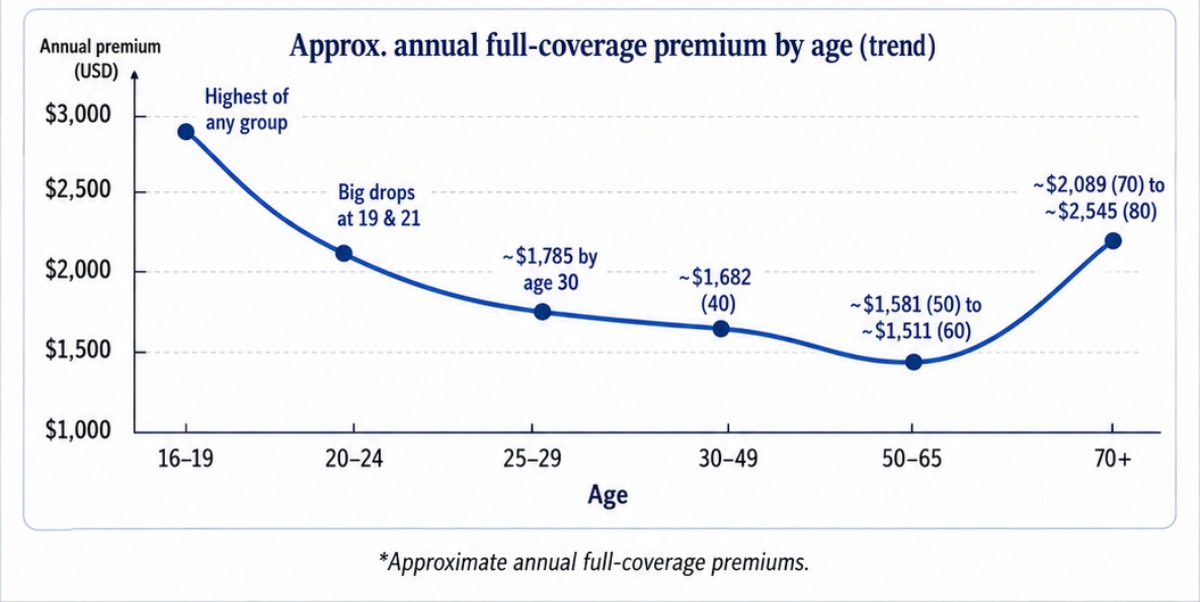
General car insurance rate pattern by age
The cheapest age for car insurance isn’t the same for everyone, but rates tend to follow a general pattern. The figures below are national averages – treat them as an educational guide, not a guaranteed quote, since your profile, state, vehicle, and coverage drive the final number.
| Age group | General trend | Approx. annual full-coverage premium* | Why it happens |
|---|---|---|---|
| 16–19 | Highest | Highest of any group | Very limited experience, highest crash risk |
| 20–24 | Falling | Big drops at 19 & 21 | More experience, but still relatively young |
| 25–29 | Noticeable dip | ~$1,785 by age 30 | No longer a “youthful operator.” |
| 30–49 | Low & leveling | ~$1,682 (40) | Strong history, better discount eligibility |
| 50–65 | Cheapest | ~$1,581 (50) to ~$1,511 (60) | Peak experience, lower risk, low mileage |
| 70+ | Rising again | ~$2,089 (70) to ~$2,545 (80) | Reaction/vision/medical-cost risk |
*\Sources: CarInsurance.com middle-age averages; The Zebra senior averages. Figures are illustrative national estimates, not quotes.
For context, one analysis (The Zebra) found the average rate rises from about $1,934 at age 60 to $2,545 at 80 – a ~32% increase. Progressive’s data shows premiums staying relatively stable from 34 to 75, then trending upward at 75+. Notably, even a 75+ premium is often still lower than what a driver in their late 40s pays.
How to make car insurance cheaper as you get older
If you want to lower your car insurance, the best strategy is to combine age-related discounts with active comparison shopping. Age may help, but you still need to make sure your insurer is pricing your current situation correctly – many drivers overpay simply by renewing automatically every year.
Compare quotes before renewal
Rates vary widely because each company weighs risk differently – a driver who looks expensive to one insurer may look low-risk to another. When comparing car insurance quotes, use the same coverage limits, deductibles, vehicle details, and driver profile to ensure a fair comparison. Re-shop especially after major life changes. Good moments to compare quotes include when:
- Your premium increases
- You turn 25, get married, move, or retire
- You buy a new car or pay off your vehicle
- Your annual mileage decreases
- A ticket or accident falls off your record
Ask about mature-driver discounts
Some insurers offer mature-driver discounts in specific age ranges (the NAIC notes these may apply between ages 50 and 65, depending on the insurer). Don’t wait for the company to offer it – ask directly.
Take a defensive-driving course
An approved defensive-driving or accident-prevention course can unlock discounts, especially for older drivers, and some states require insurers to provide them. It’s a smart move if your premium has risen.

Review your coverage limits and deductibles
Your needs change with age. If your car is older with low market value, reconsider whether collision and comprehensive still make financial sense – but be careful with liability. Reviewing the main coverage parts of an auto policy can help you cut unnecessary add-ons without creating a dangerous coverage gap. A balanced approach:
- Keep strong liability protection
- Choose a deductible you can comfortably afford
- Remove unnecessary add-ons and duplicate coverage
- Recheck coverage after major life changes
Use low-mileage or usage-based insurance
If you drive less than you used to, ask about low-mileage or usage-based (telematics) programs that reward fewer miles or safer driving habits. These are especially useful for retirees and remote workers.
Choose a vehicle that is cheaper to insure
Vehicles that are costly to repair, frequently stolen, or tied to high claim costs raise your premium. Before buying, compare insurance quotes for that specific model – a lower purchase price doesn’t always mean cheaper insurance.
Should older drivers switch insurers?
Learning to compare car insurance quotes isn’t just a beginner tip – it’s one of the smartest moves for experienced drivers too. Older drivers may qualify for better pricing elsewhere, especially if their current insurer hasn’t adjusted their rates to reflect changes in mileage, driving record, or discount eligibility.
When switching may make sense
Consider shopping for a new policy if:
- Your rate increased without a clear reason
- You retired and now drive less
- You completed a defensive-driving course
- You’ve been claim-free for several years
- You moved to a new ZIP code
- Your vehicle is older
- Your current insurer doesn’t offer senior or mature-driver discounts
- You can bundle auto and home insurance elsewhere
Don’t compare prices alone
The cheapest policy isn’t always the best. A low premium may hide lower limits, higher deductibles, or weaker claims service. When comparing insurers, review liability limits, collision/comprehensive, deductibles, uninsured/underinsured motorist coverage, PIP or medical payments, roadside assistance, rental reimbursement, claims reputation, and financial strength. A good policy is affordable and protects you from serious financial loss.
Expert tip: The drivers who pay the least aren’t always the safest – they’re the ones who re-shop. Set a reminder every 6–12 months. Five minutes of comparison routinely beats years of “loyalty.”
Common myths about age and car insurance
There are many misunderstandings about car insurance discounts for older drivers, especially regarding when rates drop and whether seniors always pay more. Clearing them up helps you make decisions based on how insurers actually price risk – not assumptions.
Myth 1: Car insurance automatically drops at 25
Rates may decrease around this age, but there’s no universal rule that premiums fall on your 25th birthday. If your rate doesn’t change, compare quotes – another insurer may price your experience more favorably.
Myth 2: Car insurance always gets cheaper every year
Age can help, but it doesn’t override inflation, rising repair costs, or claims trends. Your premium can still rise even if you’re older and claim-free.
Myth 3: Seniors always pay more
Some older drivers do pay more later in life, but many still qualify for affordable rates through low mileage, safe driving, and mature-driver or defensive-driving discounts. The better question is whether this insurer prices your current profile fairly.
Myth 4: Loyalty always saves money
Loyalty discounts help, but they don’t guarantee the lowest price. A practical rule: compare quotes at least once a year, or anytime your premium changes significantly.

RELATED AUTO INSURANCE GUIDES
Safety & Driving
How Does a Learner’s Permit Work? Rules and Next Steps
Safety & Driving
Thunderstorm Safety Tips at Home, Outdoors and in a Car
Auto Insurance
ACV vs Replacement Cost: How Insurance Payouts Differ
Safety & Driving
Black Ice on the Roads: How to spot it and handle a skid