

What is a crew cab truck? A crew cab truck is a pickup with four full-size doors and two complete rows of seating, designed to carry five or six passengers in genuine comfort. It is the largest cab configuration available on any compact, midsize, full-size, or heavy-duty pickup – and it now accounts for roughly 75% of all pickup sales in the United States. If you’ve been staring at window stickers that read “SuperCrew”, “CrewMax” or “Mega Cab” and wondering what any of it means, you’re in the right place. This guide from Auto Insure News breaks down exactly what a crew cab is, how it compares to every other cab style, which brands use which names, and whether it’s actually the right truck for your life.
What is a crew cab on a truck?
The “cab” on any pickup is the enclosed passenger compartment that sits in front of the cargo bed. Manufacturers divide that space differently depending on the configuration – and a crew cab gives passengers the biggest share.
Here’s what specifically defines a crew cab configuration:
- Four full-size doors that all open conventionally, front-hinged, on both sides
- Two complete rows of seating – not jump seats, not fold-down benches
- 40 or more inches of rear legroom in most full-size models, rivaling many luxury sedans
- Seating for five or six people, depending on whether you choose bucket seats or a front bench
- A shorter cargo bed, typically 5.5 or 6.5 feet, because the cabin takes up more of the truck’s overall length
That trade-off – more passenger space, shorter bed – is the defining tension of every crew cab purchase. Understanding it is the key to making the right decision.

What is a crew cab pickup truck, exactly?
Not every four-door pickup qualifies as a true crew cab. This is one of the most important distinctions to understand before you set foot on a dealership lot.
Some trucks have four doors but use narrow, rear-hinged “suicide doors” on the back that open against the direction of travel. Others have four doors where the rear pair is noticeably smaller than the front – technically four doors, but nowhere near the same access or comfort. Automakers sometimes use the phrase “four full-size doors” loosely, and the reality in the back seat doesn’t always match the marketing.
A genuine crew cab has:
- Rear doors that are the same size as – or very close to – the front doors
- Rear doors that open in the same conventional forward-hinged direction
- A back seat where a six-foot adult can sit upright for the duration of a long road trip
If the rear doors are noticeably narrower, or rear passengers are squeezing their knees against the front seat, you’re looking at an extended cab – not a crew cab.

A brief history of the crew cab in a truck
The four-door pickup is older than most people assume.
In 1957, International Harvester introduced the Travelette – the first four-door pickup ever brought to market. For nearly four decades, these vehicles were rare, expensive, and sold almost exclusively as heavy-duty commercial rigs. The vast majority of trucks stayed two-door, two- or three-passenger workhorses.
Then the 1990s changed everything. Americans began using pickups as their primary daily drivers rather than dedicated work vehicles. Automakers responded with a wave of four-door models, and the crew cab went from a specialty item to the standard expectation.
Today, several manufacturers have dropped the two-door regular cab from their light-duty lineups entirely. The crew cab didn’t replace the pickup truck – it became the pickup truck.
What is a crew cab truck vs extended cab? The most important comparison
This is the question that matters most for most buyers, and it’s worth understanding clearly before you shop.
The extended cab
An extended cab – also called a SuperCab (Ford), Double Cab (Chevrolet/GMC on some models), Quad Cab (Ram), Access Cab (Toyota), or King Cab (Nissan) – adds a second-row area behind the front seats, but keeps that space deliberately small.
Rear passengers in an extended cab typically have around 30 inches of legroom. That’s workable for short trips with kids. For adults on a two-hour highway drive, it’s genuinely uncomfortable. The rear doors on extended cabs are almost always narrower than the front doors, and on older designs, they hinge at the rear rather than the front – requiring the front door to be open before the rear door can swing out.
The payoff for that sacrifice is a longer cargo bed. Because the passenger compartment is shorter, the bed can be longer – sometimes up to 8 feet on a regular or extended cab where a crew cab tops out at 6.5.
The crew cab
A crew cab prioritizes the people inside. Rear legroom typically exceeds 40 inches – a full 10 inches more than an extended cab, which sounds modest until you’re sitting in the back seat of each on a five-hour road trip. All four doors are full-size. Rear passengers get genuine headroom, shoulder room, and enough space to actually use a laptop or keep a child in a rear-facing car seat without the front passenger cramping forward.
The cost is the shorter bed, and a higher price tag.
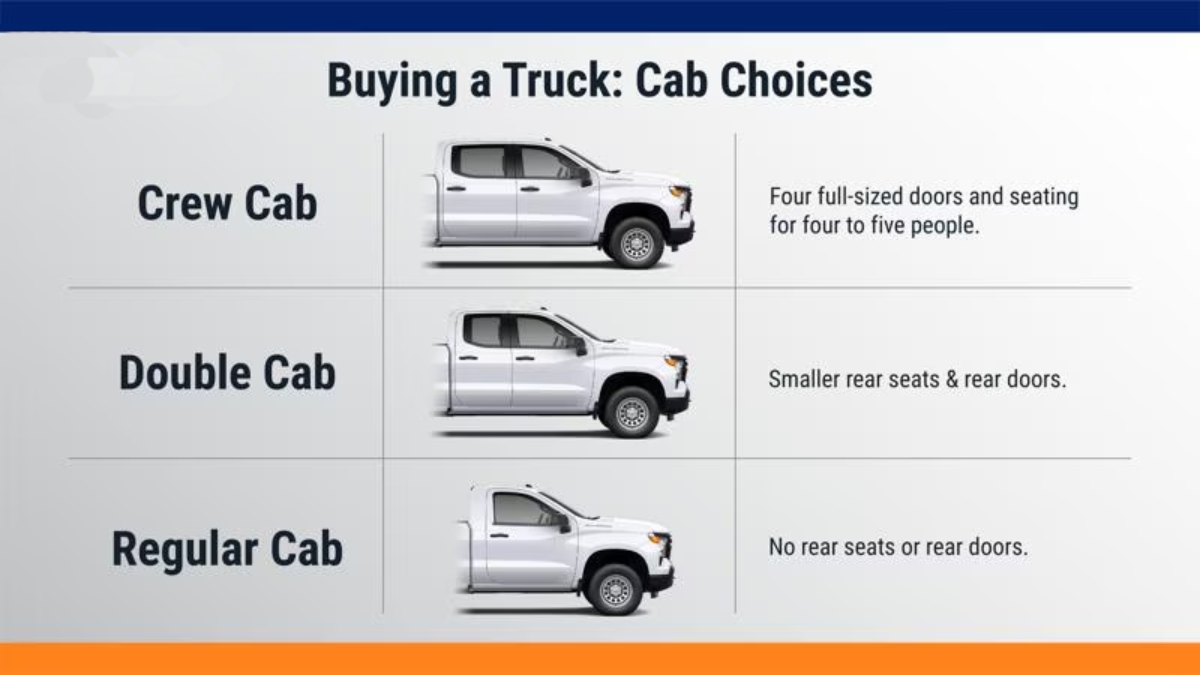
Crew cab vs extended cab: side-by-side
| Feature | Regular Cab | Extended Cab | Crew Cab |
|---|---|---|---|
| Doors | 2 | 2–4 (small rear) | 4 (full-size) |
| Rows of Seats | 1 | 2 (cramped rear) | 2 (full rear) |
| Rear Legroom | Minimal | ~30 inches | 40+ inches |
| Max Passengers | 2–3 | 4–5 | 5–6 |
| Bed Length | Up to 8 ft | Medium to long | 5.5–6.5 ft |
| Price | Lowest | Mid-range | Highest |
| Best For | Work / Fleet | Occasional rear use | Family / Daily driver |
The bottom line: If you carry adults or children in the rear seat on any kind of regular basis, the crew cab wins decisively. If you almost never use the back seat and need maximum bed length for work, the extended cab is the smarter value.
Key features that define a true crew cab
Not every four-door truck is a crew cab. Here’s what to verify before you buy:
- Four conventionally opening full-size doors. All four should open front-to-back, not rear-hinged. Rear doors should be large enough for a normal adult to enter and exit without contorting.
- A genuine rear bench or bucket seats. Not fold-down seats. Not jump seats. A proper upright seat where rear passengers can sit for hours.
- 40+ inches of rear legroom. Measure it. Don’t take the marketing sheet at face value – some manufacturers describe narrow cabs as “crew cabs” when the rear seat tells a different story.
- Seating for five or six. Standard crew cabs seat five with two front buckets. Opt for a front bench and you seat six.
- A 5.5- or 6.5-foot cargo bed. This is a natural consequence of the larger cab. If you’re seeing an 8-foot bed paired with a “crew cab” label, verify the actual rear seating measurements.
Crew cab names by brand: your complete decoder
Every manufacturer gives their crew cab a different name, which is one of the more frustrating parts of cross-shopping trucks. Here’s the full translation:
| Brand | Model(s) | Crew Cab Name |
|---|---|---|
| Ford | F-150, F-250 / F-350 Super Duty | SuperCrew |
| Chevrolet | Silverado 1500 / HD, Colorado | Crew Cab |
| GMC | Sierra 1500 / HD, Canyon | Crew Cab |
| Ram | 1500, 2500 / 3500 | Crew Cab |
| Ram | 2500 / 3500 (extra-large variant) | Mega Cab* |
| Toyota | Tundra | CrewMax |
| Toyota | Tacoma | Double Cab |
| Nissan | Frontier, Titan | Crew Cab |
| Honda | Ridgeline | (No designation – all Ridgelines are crew cabs) |
| Jeep | Gladiator | Crew Cab (only option available) |
| Hyundai | Santa Cruz | Crew Cab (only option available) |
The Ram Mega Cab is a heavy-duty-only configuration that provides even more rear legroom than a standard crew cab – designed for buyers who want maximum interior space over bed length.
Important: Always verify actual rear legroom measurements from the spec sheet rather than trusting the marketing name alone. Two trucks both calling themselves “crew cabs” can have meaningfully different back seats.
What is a truck crew cab in the EV era?
One important development the original crew cab conversation rarely covers: every major electric pickup truck on the market today is a crew cab – and electric trucks are reshaping what buyers expect from the configuration. Before comparing an electric truck with a gas model, it is worth understanding why are electric cars so expensive in the first place.
- Ford F-150 Lightning SuperCrew – The electric version of America’s best-selling truck retains the SuperCrew cab and adds a front trunk (“frunk”) that doubles as a second storage area. The Lightning offers up to 230 miles of range and bidirectional charging that can power your home during an outage.
- Chevrolet Silverado EV Crew Cab – Built on GM’s Ultium platform with an available 450-mile range, the Silverado EV retains the full crew cab footprint and adds a mid-gate that extends cargo space from the cab into the bed.
- GMC Sierra EV Denali Edition 1 – The premium sibling to the Silverado EV, with the same crew cab layout and an emphasis on luxury trim and technology.
- Rivian R1T – A purpose-built electric adventure truck from a startup, offered exclusively as a crew cab. It adds a “gear tunnel” between the cab and bed for weatherproof gear storage.
- Ram 1500 REV – Ram’s full-size electric truck, arriving in crew cab configuration with a focus on towing range and the longest available battery option in the segment.
Electric crew cabs offer the same passenger-space advantages as their gas-powered counterparts, with the added benefit of frunk storage that partially compensates for the shorter bed. If you’re considering an EV truck, the crew cab is the only option – and for most buyers, that’s not a compromise.

Popular crew cab trucks right now
Full-size
- Ford F-150 SuperCrew – America’s best-selling vehicle for 50 consecutive years. The crew cab SuperCrew configuration is available with a hybrid powertrain, a fully flat-folding rear floor, and trim levels ranging from stripped work trucks to genuine luxury interiors.
- Chevrolet Silverado 1500 Crew Cab – A strong all-rounder with an available carbon-fiber composite bed, multiple powertrain options including an inline-six turbo-diesel, and a rear camera mirror system that’s genuinely useful when the bed is loaded.
- GMC Sierra 1500 Crew Cab – Shares its bones with the Silverado but leans harder into premium materials. The Denali and Denali Ultimate trims offer some of the finest interiors in the full-size truck segment.
- Ram 1500 Crew Cab – Famous for its coil-spring rear suspension, which delivers a noticeably smoother ride than competitors using leaf springs. Interior materials and noise isolation are class-leading.
- Toyota Tundra CrewMax – The only full-size truck with a standard hybrid powertrain across the lineup. Distinctive styling and Toyota’s long-term reliability reputation make it a strong choice for buyers keeping trucks for many years.

Midsize
- Toyota Tacoma Double Cab – The legendary midsize with resale values that rival luxury vehicles. The new generation adds a more refined interior and available hybrid option while keeping its off-road reputation intact.
- Chevrolet Colorado Crew Cab – Completely redesigned with genuinely better on-road driving dynamics and a more modern tech package. Available with a 2.7-liter turbocharged four-cylinder that punches above its weight.
- Ford Ranger SuperCrew – Compact footprint with serious off-road capability in the Raptor variant. A strong choice for urban drivers who still want weekend adventure capability.
- Honda Ridgeline – The one unibody truck on the market. It rides, handles, and parks more like a crossover SUV than a traditional pickup, which is either a selling point or a disqualifier depending on your needs. All Ridgelines are crew cabs by default. The in-bed trunk is genuinely clever.
- Jeep Gladiator – The only four-door, removable-top, go-anywhere truck on the market. Built on Wrangler DNA with Wrangler capability, the Gladiator is available only as a crew cab. The bed length is shorter than most competitors’, but you can remove the doors and roof, which no competitor can offer.
- Hyundai Santa Cruz – The newest entrant in the midsize crew cab space. Smaller than a Tacoma, with a more car-like ride and a clever dual-access bed. It’s the best option for urban drivers who want cargo utility without committing to the size of a traditional truck.

Heavy-duty
- Ram 2500 / 3500 Crew Cab & Mega Cab – Built for serious towing. The Crew Cab handles conventional gooseneck and fifth-wheel trailers; the Mega Cab adds exceptional rear-seat space for long-haul drivers who spend time in the cab between job sites.
- Ford F-250 / F-350 Super Duty SuperCrew – Purpose-built for maximum recreational and commercial towing. The available Tremor and high-output diesel configurations make this the choice for buyers who regularly haul at or near capacity.
- Chevrolet Silverado HD Crew Cab – Shares the full-size’s refinement but adds heavy-duty towing credentials. The Duramax diesel option remains one of the most proven engines in the segment.
The honest caveats: what marketing won’t tell you
Here’s what the window sticker glosses over.
- “Four full-size doors” isn’t always true. Some manufacturers use this phrase to describe trucks in which the rear doors are noticeably narrower than the front doors. Always sit in the back before you buy. If your knees are near the front seat, you may be in an extended cab regardless of how it’s labeled.
- Compact crew cabs are genuinely small inside. The Hyundai Santa Cruz and Ford Maverick are crew cabs by technical definition, but their overall footprints make the rear seat feel cramped compared to a full-size. The label doesn’t guarantee the legroom.
- Towing ratings are slightly lower than those of equivalent extended- or regular-cab models. The heavier cab adds curb weight, which marginally lowers tow ratings. If you’re buying a crew cab specifically to maximize towing, verify the spec sheet for the exact configuration you’re considering.
- Parking in dense cities is a real problem. A crew cab full-size truck can exceed 22 feet in overall length. Many urban parking structures have 20-foot pull-through limits. This isn’t a dealbreaker for most buyers, but if you live in a dense city, spend a week thinking honestly about where you park every day.

Why the crew cab became the default American truck
It is no accident that this cab configuration now controls three-quarters of the market.
For most of the truck’s history, buyers had to choose between a work tool and a people mover. The crew cab erased that choice. You can tow a boat on Saturday, drop four kids and their gear at practice on Wednesday, and still carry a weekend’s worth of lumber in the bed. No other vehicle configuration does all of that. If towing is not important and you prefer a sedan, a toyota camry review offers a useful alternative ownership perspective.
The interior quality has also transformed the value proposition. Modern crew cab trucks offer panoramic sunroofs, 12-inch touchscreens, massaging seats, and rear-row climate control. The Ram 1500’s interior is widely considered better appointed than that of many European luxury sedans at equivalent price points. Buyers who would have purchased a three-row SUV five years ago are increasingly choosing crew cab trucks instead – and keeping the towing capability as a bonus. If you are deciding between a compact and three-row SUV instead, compare the toyota rav4 vs toyota highlander before choosing a truck.

How a crew cab affects your auto insurance
Your cab configuration has a measurable effect on what you pay for coverage, and most buyers don’t find this out until after they’ve signed the paperwork. For an off-road alternative, comparing typical jeep wrangler insurance costs can add useful context.
Why crew cabs cost more to insure:
Crew cabs carry a higher MSRP than equivalent regular- or extended-cab trucks. Because collision and comprehensive coverage are tied to the vehicle’s replacement value, your premiums for those coverages will be higher than they would be on a two-door work truck with the same engine and drivetrain.
Where crew cabs can save you money:
Because crew cabs are frequently used as primary family vehicles, manufacturers build them to meet the most stringent crash test standards. Strong NHTSA and IIHS safety ratings can translate to lower liability premiums – sometimes partially or fully offsetting the higher comprehensive cost.
The practical steps: Once you choose a truck, use this what to do after buying a new car checklist to organize insurance, registration, and early maintenance.
- Get quotes before you buy, not after. Run the VIN or trim level through at least three carriers to understand the insurance cost of the specific configuration you’re considering.
- Compare crew cab vs extended cab insurance costs on the same model. The premium difference is often smaller than buyers expect – sometimes under $15/month – and many buyers find the crew cab’s safety ratings make the actual premium difference negligible.
- Ask specifically about bundling discounts if you’re insuring multiple vehicles. Truck insurance bundled with a home policy can be significantly cheaper than standalone coverage.
- Usage matters. Carriers treat a truck used as a daily commuter vehicle differently than one used primarily for work or hauling. Make sure your declared usage accurately reflects how you’ll actually drive it.
Who should buy a crew cab truck
Buy a crew cab if:
- You regularly carry adults or children in the rear seat – even once or twice a week
- This is your primary vehicle rather than a dedicated work rig
- You have young children and need accessible LATCH anchor points and room for rear-facing car seats
- You tow on weekends and want family members in the cab with you
- You value resale value – crew cabs hold their value better than other cab configurations due to higher demand
Consider an alternative if:
- You require an 8-foot bed for full sheets of plywood or extended lumber
- You are on a strict budget and carry rear passengers only occasionally
- You live in a dense urban environment and park in structured lots daily
- You almost always drive solo – in that case, the extra cabin adds cost without adding utility, and an extended cab gives you the same engine and towing for less money
If a crew cab feels too large for your daily driving, compare smaller SUV alternatives such as the honda cr-v vs honda hr-v before choosing a vehicle that adds more size and towing capacity than you need.
Frequently asked questions
What is a crew cab truck vs a regular cab?
A regular cab (also called a standard cab) has two doors and one row of seating for two or three people. There is little to no usable space behind the front seats. A crew cab has four full-size doors and two complete rows of seating for five or six people, with 40 or more inches of rear legroom. If you regularly need to carry more than two passengers, a regular cab won’t work for you.
What is a crew cab truck vs extended cab?
An extended cab adds a second row behind the front seats but keeps that area small – around 30 inches of legroom – and typically uses narrower rear doors. A crew cab provides 40 or more inches of rear legroom, full-size doors on both sides, and genuine long-trip comfort. The trade-off is that a crew cab comes with a shorter cargo bed than an equivalent extended cab.
Is a crew cab always a 4-door truck?
Yes. A crew cab is always a four-door configuration. If a pickup has only two doors, or rear doors that are noticeably smaller and rear-hinged, it is a regular cab or extended cab – not a crew cab.
How do I tell if a truck is a crew cab or a quad cab?
Count the doors and measure the rear ones. Both have four doors, but a Quad Cab (Ram’s name for their extended cab) uses narrower rear doors and offers about 30 inches of rear legroom. A Ram Crew Cab uses full-size rear doors and 40-plus inches of rear legroom. When in doubt: sit in the back seat. If your knees are near the front seatback, it’s a Quad Cab.

RELATED AUTO INSURANCE GUIDES
Safety & Driving
Hot Car Safety Tips for Children, Pets and Drivers
Safety & Driving
How Does a Learner’s Permit Work? Rules and Next Steps
Safety & Driving
Thunderstorm Safety Tips at Home, Outdoors and in a Car
Auto Insurance
ACV vs Replacement Cost: How Insurance Payouts Differ