
Update: This story was updated to include information aboutthe 2021 Ford F-150 Raptor.
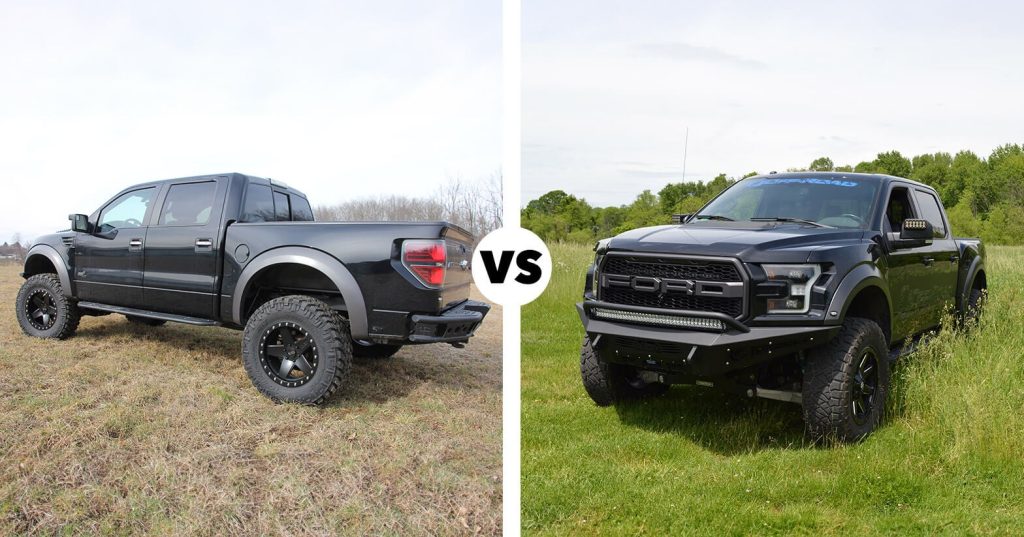
The Ford F-150 Raptor pickup feels like a long-running staple, but there have only been two of them (with Ford only recently revealing the new third-gen model). The original was introduced for 2010 and lasted through 2014 before being replaced by the second-generation model in 2017. Both are hugely upgraded F-150s with awesome suspension modifications, muscular flared fenders, and big-horsepower engines for bashing around off-road at high speeds. So, what are the differences between the first- and second-generation Ford F-150 Raptors? Plenty.
For the sake of clarity, we’ll contrast a 2014 Raptor (the final model year for the first generation, with its bigger engine) with a 2020 Ford F-150 Raptor, the latest second-generation model. Many of the changes are F-150-specific rather than Raptor-specific, basically meaning that the biggest contributors to Raptor changes between 2014 and 2020 are technological advancements and aesthetic tweaks to the underlying F-150. Therefore, the goal is not to label one as “good” and the other as “bad”—we’d drive and own either—and if we were rich, both. Instead, we’re just serving up talking points for your next friendly argument with friends over the pros and cons of each.
What Makes a Ford Raptor Special? SVT vs. Ford Performance
Sure, it’s a technicality, but to some, it matters. The 2010-2014 F-150 Raptors areSVTRaptors, while second-generation Raptors are branded Ford Performance Raptors. The Ford Special Vehicle Team (SVT) launched during the 1992 Chicago Auto Show, creating high-performance halo vehicles for the Ford lineup under the core values of performance, substance, exclusivity, and value and acting like a sub-brand similar to BMW M or Mercedes-AMG. Before turning its attention to the F-150 Raptor, the SVT team also developed the F-150 SVT Lightning(1993-1995, and 1999-2004) and cars such as the Contour SVT and Focus SVT, plus a Mustang or two. Ford Performance, which basically absorbed SVT and Ford Racing under a single umbrella in 2014, was therefore responsible for the second-generation Raptor.
The SVT Raptors could be viewed as more exclusive since there were fewer of them made per model year than the Ford Performance Raptors. SVT Raptor owners like to point out all the interior and exterior SVT badging on their trucks and hang on to SVT truck parts. The second-gen Raptors don’t display an abundance of Ford Performance branding, but, then again, neither truck really needs special badging to stand out.